NewHire spent half of the day Monday, January 19 at the Anti-Cruelty Society in Chicago.
NewHire is a recruiting software company. When you think “software company”, you think “computers”, not people. Computers are great. But, when is the last time you saw a computer do THIS?
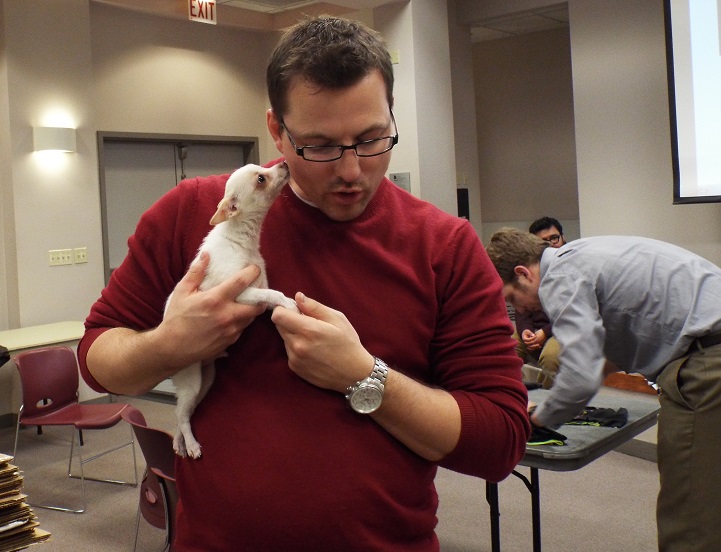
Bob, a NewHire account manager, and Seymour, a Chihuahua, hanging out at the Anti-Cruelty Society.

Eddie, a numbers guy, is also a puppies guy. Who knew?
Awww.
That’s right. At NewHire, we do things a little bit differently. We’re not just a few lines of code that make life a little easier. We are also real, reliable people. When you call us, a human answers the phone. Unless, of course, we’re at the Anti-Cruelty Society spreading the love with these adorable little furballs.

Eagle Eye is an adult Saint Bernard. He was so happy to see us that he smiled for a photo!

Pandora, a calm and cool female adult Shorthair mix, was less impressed.

Seymour, a 2 month old and part of a set of triplets (aptly named Phillip, Seymour, and Hoffman,) joined us for arts and crafts time!

Here’s Conor, a staffing coordinator at NewHire, with Phillip and Hoffman.
The Anti-Cruelty Society welcomed NewHire with open arms, not just to play with the pets they have up for adoption, but to help provide them with easy-to-make beds, tug-toys, cat-scratchers, and various other play-things.

Seymour even made off with one of his own…

…and he got a little tied up in the fun.
As happy as we were to give back, we couldn’t have done it without the kindness and welcoming help of our friends at The Anti Cruelty Society.

The afternoon group (left to right) Bob, Alicia and Sean, with some of the supplies we helped make.
If you wish to visit the Anti-Cruelty Society to adopt a new pet, help care for the facility, or donate, visit them online at http://anticruelty.org/

See you soon!