Archives For Recruiting ROI

Using a recruiter can be a great way to save you time, energy and resources when hiring. We all know it’s not a quick (or easy) process, but sometimes you just need a little help. Is using a recruiter hurting you more than helping you? That scenario is definitely possible. Keep reading to figure out if your recruiter is a pro or a con.

using a recruiter hurting Quiet, monotone, unenergetic, negative, mean and even down right rude.  These are the perfect adjectives to describe the next Bond villain but maybe they aren’t perfect adjectives to describe your recruiter. If the aforementioned adjectives could be used to describe your recruiter, it’s highly likely using a recruiter is hurting your chances.

As a candidate who is interested in a position within your organization, I want to work with a recruiter who I wouldn’t mind seeing in the office every day. If your recruiter is kind, friendly, helpful and really organized, you can bet they are helping you hire. Remember, job candidates are screening you too. You need to put your best foot forward from the very beginning.

A recruiter within an organization can wear many hats, but their number one job is to present you with qualified candidates.  The recruiter was hired to hire!  Through a set of processes, they present qualified candidates to the decision makers of the company. There are a number of pro tips and tricks we’ve compiled over the years we’ve been helping small and medium businesses hire.

Let’s look at the things that will hurt you more than help you:

  • Your recruiter has a bad attitude or bad vibe
  • The recruiter isn’t excited about the company or position
  • The recruiter isn’t selling the opportunity
  • The hiring managers don’t trust the recruiter’s decisions
  • The hiring managers aren’t seeing qualified candidates
  • There is no recruiting process or organization
  • The recruiter isn’t following up with candidates

If any of those sound familiar to you, using a recruiter is hurting you when trying to hire. But don’t worry too much. Using a recruiter isn’t always bad, and it can actually be extremely efficient and helpful!

Here are the things that will making using a recruiter helpful to your organization:using recruiter helping

  • The recruiter answers the phone as if they are the one interviewing
  • The recruiter always has a positive attitude
  • The recruiter presents the company in a positive and professional manner
  • The recruiter keeps detailed notes in a database
  • The recruiter is excited about the job and company
  • The hiring managers trust the recruiter’s decisions
  • The recruiter gives the candidate feedback
  • There is an outlined and consistent process including follow up

Does that sound familiar? We hope so. Because that means your recruiter is absolutely helping you make the right hire!

Using a recruiter is something many people are on the fence about because they don’t want to find themselves resonating with the first list. The question isn’t necessarily whether or not you should use a recruiter, because clearly they can be very helpful, but it’s about finding the right recruiter. You want one that’s going to help, not hurt. They’re out there. You just have to be selective.

This is the third of a three-part series that’s designed to help you answer the question “why is it so hard to hire an employee?” 

We’ve addressed what may be the problem if no one is applying for your job and why qualified applicants aren’t applying, but what if you have plenty of qualified candidates applying? You might be thinking, “what’s the problem?” The obvious answer is: There is no problem with having plenty of qualified candidates. The problem comes when you have no follow up.

What do I do if I have plenty of applicants but no follow up?

Don’t kick yourself for not following up. It happens. There are many reasons why you may find yourself lacking in this department.

no time to hire an employeeMost small- and mid-sized employers wait to hire an employee when there is enough business to support a new employee. That means that everyone in your office is currently working at capacity. Everyone is slammed handling customers, orders and other immediate tasks. That doesn’t leave anyone with the time needed to properly hire an employee.

Other times, we find ourselves hiring in “emergency mode.” When people take new jobs, retire or get fired suddenly, you need someone quick. But you also need to get their work done. No wonder you don’t have time to follow up; you’re currently doing two jobs!

Maybe you’re not slammed for time but there is no clear delegation of work responsibility for following-up with the top candidates. The President, Owner or manager got the ball rolling, but is too busy to see to the details. Who takes it from there?

Or perhaps it’s just too much to handle in additional to the regular work load. That’s possible. Especially in the case of smaller companies that might not have a dedicated HR staff or recruiter.

It takes a lot of time to hire an employee, so it’s certainly not something you can “just squeeze in.”

hire an employee phone interviewConsider this: It takes 30 to 45 minutes to conduct a phone interview. Let’s say you want to conduct 10 or 12 phone interviews so you can have 3 or 4 quality candidates for face-to-face interviews. That’s 540 minutes or 9 hours just to do the phone interviews. Wow! No wonder you don’t have time.

That 9 hours doesn’t include the time it takes to identify the best applicants, or the time it takes to send emails, set appointments, leave voicemails, or deal with the interruptions when the candidates call back. And all of those steps must be taken. That’s a lot of time!

So what do you do? You either work crazy hours, shift priorities or you can ask for help. There is nothing wrong with reaching out for help, but it’s best not to wait too long to do that. The best candidates don’t stay on the market for long.

As soon as you recognize that you don’t have the necessary time required to hire an employee, take action to remedy it. Either shift priorities or reach out to someone that can help bear some of the burden. We don’t recommend the ‘work crazy hours’ option.

For more information read Part 1 and Part 2 of this series.

If you are having this problem now, feel free to reach out to us. We’re pros at helping you find the right person for your job.


Today’s jobseeker landscape has vastly changed from how it appeared only a few short years ago. Job boards like HotJobs and Monster.com have all but disappeared from our regular referral sources, while new boards like Indeed have exploded in usage. Job seekers tend to sway in what boards they favor like teenage girls to the newest boy bands; what was trendy four years ago is no longer “in” and what is popular now might not be in the future. The importance of social media as a source for jobs seekers is reflected in LinkedIn’s steady presence on our lists of preferred referrers.

During the past four years, Indeed experienced explosive growth, nearly doubling the number of annual job-seeker views per NewHire job since 2010. CareerBuilder and Craigslist have declined steadily. And for the first time ever in 2013, Craigslist edged out CareerBuilder. LinkedIn remains a very steady board, providing a stable number of job- seeker views to NewHire jobs each year.

CareerbuilderG1ReferralsPerJob-1- Large Key

In 2010 CareerBuilder was the top performing job board with Craigslist in a clear second place. Today the lay of the land in recruitment advertising is changed. Indeed is the clear winner.

But there are other players that can’t be ignored. In second place, receiving the silver medal, is a category we call “other”. It is made up of 100s of Niche job boards, employer careers pages, emailed jobs and Google searches. This category is like the relay team – energizing the recruiting landscape with many less well known players. Together these sites play a key roll in attracting candidates. Is next year’s big winner hiding in this category? We don’t know, but stay tuned because as surely as daffodils bloom in spring, the recruitment advertising market will change in the coming four years.NicheJobBoards_NumberOfBoardsPerYear

The rise of these niche job boards is part of the reason why things are not completely doom and gloom for CareerBuilder. While it may not contribute as many candidates as Indeed, it does play an important part in the “spider web” effect of spreading posted jobs to its partner sites such as Headhunter and MoneyJobs. Combined with our highest application rate of 38%, there are still compelling reasons to keep CareerBuilder a part of your recruiting process.

More about the data and how we get it:

As a provider of applicant tracking software and recruitment advertising services to companies with 1000 or fewer employees, NewHire is in a unique position to provide independent data on job board performance.

In the past, we’ve blogged about the importance of Indeed as a source for candidates – the people who actually apply for the job, not just job seeker views. In the data shown here we’ve expanded– going back four years – to get a more general look at how both Indeed has risen up – and CareerBuilder and Craigslist have tumbled.

Below is a table showing the detailed results of this four year effort.

table info reformatted_ecantave

First – let’s look at the number of unique NewHire jobs each year that received views from key job boards including CareerBuilder, Craigslist, Indeed and LinkedIn. We’ve also included the category of “Other” as a catch all for many smaller niche boards and our own NewHire Job board. Every NewHire job with a job-seeker page view sent by one of these boards was counted.

As the employment market has steadily gained steam, you can see the number of jobs advertised on each board has steadily increased.

So, with increasing number of jobs advertised, you might think our referral numbers also show a corresponding increase, correct? Not according to the data we examined. CareerBuilder shows a small gain before sliding in 2012. Craigslist, on the other hand, rises through 2012 and then falls off in 2013, while Indeed explodes in popularity, growing each year. The only job board to actually follow the pattern we expected is LinkedIn, which showed modest increases in traffic each year as more jobs were added. Finally, the last column of the table shows the annual number of referrers per job. CareerBuilder and Craigslist lost the most ground, and Indeed gained the most over the past four years.

What does this really say about Job Board performance?
• Make sure your job is featured on Indeed
• Don’t discount advertising on other boards as they bring views, candidates, and links that all help drive the category called “other”.
• Take advantage of the interconnectivity of the web and social media sharing to help us help you get the right candidates!

Stay tuned as we delve further into that mysterious “Other” category in future blogs!

iStock_000007455150Small

Having experienced thousands of job openings and millions of candidates at NewHire, one lesson is clear: Every recruiting project moves from the “ideal world of the job description” to “the real world of the people actually interested in your job.”

Perfect candidates are an extremely rare breed. This Harvard Business Review article (link: http://blogs.hbr.org/2013/01/dont-hire-the-perfect-candidat/) calls them “purple squirrels.” We tend to call them “flying mermaids.” However you think of them, there’s nothing wrong with finding the perfect candidate — if you can do it in the time frame required to meet your business objectives. When you find a candidate like this, think of it as a happy accident.

As in most of life, timing is everything. The bigger your hurry, the more compromising you must do. The higher the stakes, the more careful you feel you must be. Let’s look at two real-life scenarios to illustrate what we mean:

Scenario 1.

You have an opening for a sales representative (I know… you always do) on your team of five. People are a bit stretched covering the open position, but not impossibly so. Your Sales Manager is spending measurably less time coaching and more time selling, so this hurts the overall sales effort. Given the cost of the hire, the initial training and a significant ramp-up time, you’re looking at an investment of $50,000 to $60,000. You’ve seen six candidates who have been through a multi-step recruiting process, including a positive result on a sales assessment that you believe in. You’ve been at it for 90 days. Each of the candidates has significant pros and cons. Do you pick the best of the bunch or keep looking?

Scenario 2.

You own the business and it has been good, growing, and modestly profitable. You’ve been at it for six years and now you are thinking it’s time to bring in a General Manager or COO who will help you to the next level. You want to add more professional management experience to your organization. You want time to work on new products and spend more time with customers. People tell you that you’ll have to pay $110,000 to $130,000 to get the right person. Having mentioned your interest to a few colleagues, referrals are trickling in and you’ve met with three candidates. You liked one of them a lot, but she’s in demand and likely has other offers. Do you take the plunge and hire her?

Here are our answers:

Scenario 1: Pick the best of the bunch and get a sales rep hired.

Yes, it’s a significant investment and you want to get it right, but the cost of doing nothing exceeds the risk of hiring the wrong person. It’s difficult to calculate lost opportunity, but you know it’s there. Without a fully functioning sales machine it’s difficult to grow. Use 30, 60 and 90 benchmarks to measure whether your new hire is on the path to success. Keep sourcing, screening and interviewing candidates… there’s never a wrong time to hire a purple squirrel sales rep. Build the cost of sales rep turnover into to your annual budget so that you don’t fret every time a sales rep fails… it happens.

Scenario 2: Slow down! Back up and start over.

We are not opposed to “opportunistic hires,” but the business owner in this scenario has not spent any time clearly defining the role and responsibilities, nor have they thought about the behaviors and motivations that the GM or COO job would reward. What is the owner’s behavior profile? Should the new hire have the same kind of profile or should it be different, filling in leadership and management gaps. Would a hire coming from a large organization with a strong history of implementing corporate best practices be a good idea? Is the referral he liked, “the best available talent?” He doesn’t know WHO he doesn’t know, so expand the pool of candidates dramatically. Kiss a lot of frogs. It helps you identify when you’ve found your prince.

How many people do you interview for each position before you hire?


Help Wanted v2

Few things are as frustrating to business leaders as hard-to-fill jobs. These talent bottlenecks slow company growth and cost real money. But the law of supply and demand shows no mercy. If you want to hire any of the following, chances are you’ll find few candidates to choose from:

  • Software Developers
  • Truck Drivers
  • Sales Representatives
  • Engineers (of all kinds!)
  • CNC operators and other manufacturing staff
  • This list could really go on and on… Digital Marketing Experts, IT Technicians, Senior Executives, etc.

With so many people out of work, how can it be so hard to find the people you need? Here are 5 factors that can make a job hard to fill and suggestions that may help:

  • Small pool of trained candidates – you’re buying new machines with new technologies like the latest CNC (you may have to train them yourself)
  • Poor Geography – your business is located in a place that has few trained workers (consider hiring remote staff)
  • Under-market compensation – it’s called the “War for Talent” for a reason and if your comp plan isn’t competitive you should consider paying more (yes, you may have to raise your prices too)
  • Unappealing advertising – the candidates may be out there but you are not appealing to them in a way that moves them to apply (you have to tell them “what’s in it for them”)
  • Challenging company reputation – do you know how prospects (both job candidates and potential clients) feel about your company? (check your online reputation and address any problems you find)

When you need what you need and can’t get it, it’s easy to blame the messenger whether that’s your HR person, Executive Recruiter, or job board. And, sure, if the people you have working on this critical business problem aren’t putting in the effort, following all the leads and trying all available methods, you have a right to be frustrated. But what if they are?

You have two choices:  1) keep doing what you’re doing and wait patiently for the right person to come along, or 2) change something. You can look for less experience, pay more money, cast a wider net with more advertising, promote from within and hire for that easier-to-fill open position.


What’s it going to be?

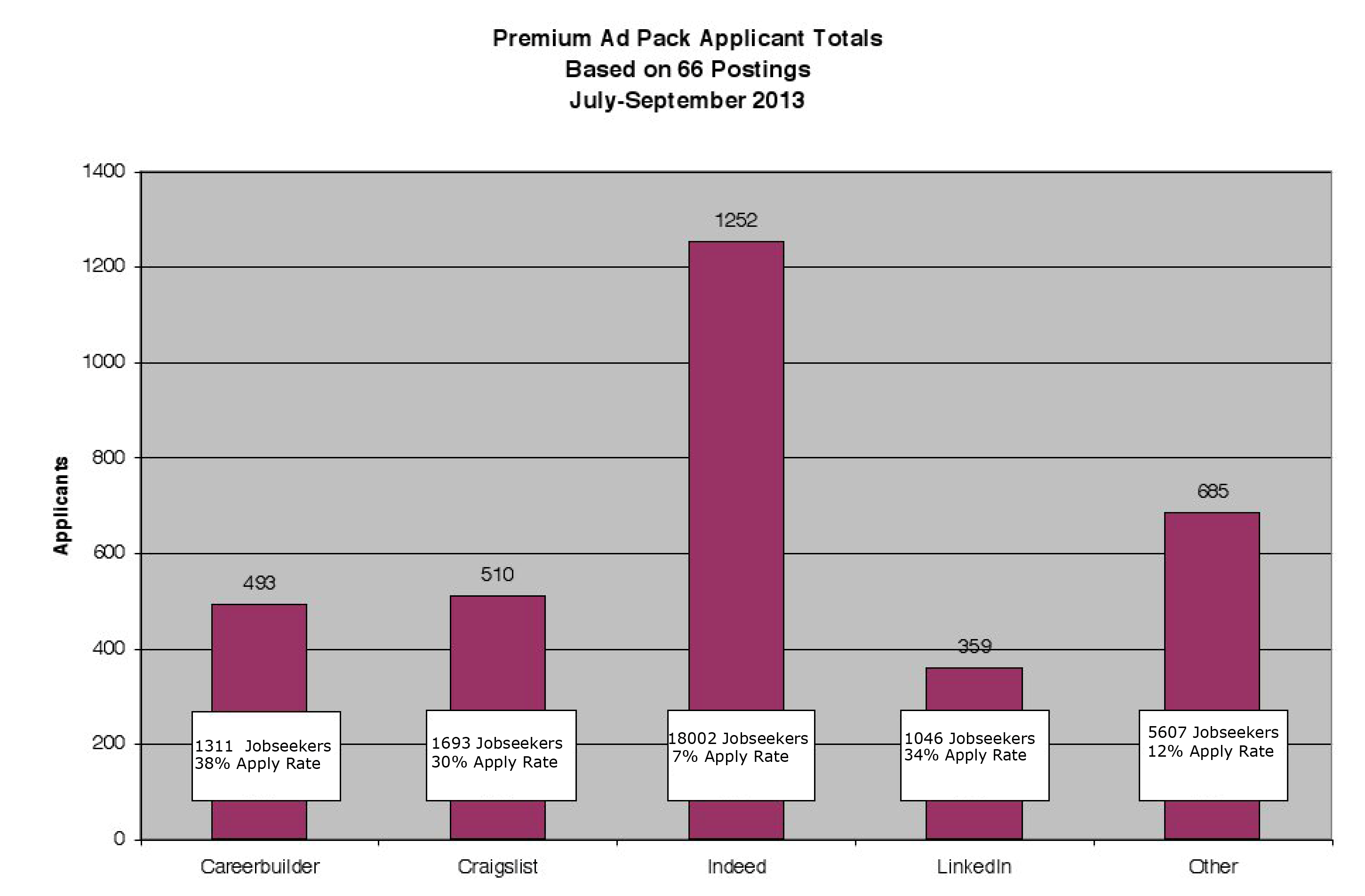
Indeed is the current juggernaut in the online recruitment advertising, delivering 38% of all applicants to a sampling of 66 open positions. This is more than any other single job board. The runner up, CareerBuilder, does not even come close. But that’s not the whole story because the combination of Careerbuilder, LinkedIn, Craigslist and all other boards delivered 62% of the total number of job applicants.

When sourcing candidates you can’t know in advance which source is going to provide the person you will hire. So our data shows that it is important to advertise your open position to as many jobseekers as possible.

In a previous blog, “Top Job Boards in 2013”, we explored which job boards delivered the most job-seekers. Our next step was to find out which of those job-seekers turn into applicants. What we found surprised us, and we think it might surprise you too.

The application rate — the conversion from job-seeker to applicant — from Indeed is far and away the lowest of any site surveyed. A strikingly high percentage of the job-seekers coming from CareerBuilder and LinkedIn are completing the applications.

Google Analytics Premium Ad Pack Applicant Totals Jul-Sept 2013 - small

Indeed accounts for almost 3 times the number of applicants than any other job board. We expected Indeed to be the leader because Indeed provides 10 times the number of job-seekers as the runner-up. But, the application rate from Indeed is the lowest of any site surveyed.

Here’s the first surprise: A high percentage of the job-seekers coming from CareerBuilder and LinkedIn are completing the applications. The application rate (conversion of job-seekers to candidates) is 38% for CareerBuilder, 34% for LinkedIn and 30% for Craigslist, while Indeed’s application rate is a lowly 7%.   

Here is what we think is happening. Applicants who use Indeed only see a small snippet of the ad. To see the entire ad, they have to click through and view NewHire’s application page, boosting Indeed’s job-seeker statistics. In comparison, applicants using CareerBuilder or LinkedIn can see the entire text of the ad and don’t need to click though. If they do click through, they are more likely to apply for the job.


The world of “other” job-boards continues to surprise.

The right bar in the graph labeled, “other,” is a combination of every other job site that referred job-seekers and applicants to NewHire. This group of “other” job sites sends us our second highest number of applicants and job-seekers. It’s crazy that the #2 performer is coming from sites that we don’t intentionally post to.

With thousands of smaller job-sites around the web continually picking up each other’s jobs, the Internet is working its interlinked magic to bring you more candidates.

So what does it all mean to you?

As job boards and aggregators feed into each other, the number of people who have access to your job ad increases. The job ads will even feed into sites that you never expected, driving more traffic. Continue posting job ads on a wide range of websites to maximize your exposure and build your pool of candidates!

How did we get all this data?

This graph shows the total number of applicants who applied to NewHire jobs between July and September 2013. Each of the 66 jobs shown here were advertised on the job boards shown, during concurrent time periods. All job-seeker and applicant data is gathered from Google analytics. A job-seeker viewed the NewHire application page while an applicant submitted the NewHire application with the minimum required fields.

 business question


Every one who has placed an online recruitment ad knows that it isn’t as easy as it seems. It isn’t easy to figure out which job boards to use. It takes time to actually get the ad posted on each job board, especially if you don’t do it very often.

On the other hand, it IS easy to be filled with doubt, leaving you wondering if the money and time you’ve spent will yield the desired result – a qualified candidate to hire.

Here are a few secrets to recruitment advertising success!

1. Use a common and familiar job title.

The job title is like a blog or newspaper article headline – it’s your best shot at getting candidates to read the rest of your ad. The job title is also the most important way to help the right candidates find your ad when they search. Use a common job title that other companies are using for jobs with similar duties and a similar salary range as the one you are recruiting for.

2. The ad copy matters.

The information you provide and the way you present that information has a big impact on the success of the ad. Think about the ideal candidate and make the ad attractive to them.

Recruitment advertising is a marketing and sales piece, not a screening tool. Does your ad say “Don’t apply unless…” If so, get out your favorite red pen and ask your self “what would my high school English teacher do to improve this ad?” Here are a few hints:

  • Does the ad sell the job and the company?
  • Do you list some cool, interesting or surprising things about the opportunity?
  • What’s great about the opportunity? Is it in the ad?
  • Do you say what’s in it for the candidate? Money? Perks? Vacation? Benefits? Work from home options?

3. Keep it short and easy to read.

People don’t read every word they see. How could they…there are so many words from so many sources. Candidates have many ads competing for their attention. You’ll be lucky if candidates scan the first paragraph to see if it’s worth further time investment. Combat this problem by:

  • Highlighting the most important information at the top
  • Using bolding, bullets, and short paragraphs to grab attention
  • Using active and engaging language
  • Include only 5 of the most important duties or requirements. (I wouldn’t read a list that is 25 items long, would you?)

4. Don’t be cheap.

Free is nice, but you get what you pay for. Brand name job boards and niche job boards are worth the money. At NewHire we track advertising ROI – so if you want to know where to get the most for your money – read these blogs.

If you know that the open position is going to be a challenge to recruit for, (because it is a high skill, high education, or high demand opportunity) be prepared to advertise widely, and spend a bit more money.

5. Use your network.

Social media is an important way to network, so post the job opening on LinkedIn, Facebook, and your company website. But don’t neglect word-of-mouth, your alumni association, other employees, or your mother-in-law – let people in your network know that you’re hiring.

6. I know – I said 5 secrets—but here’s the last one – I promise.

The real secret is that you can’t do just one of these things – you need to do them all, and do them well, to hire successfully. If you feel like you need a little help with your recruitment advertising – don’t worry you’re not alone.


Need help? Just ask.

http://www.flickr.com/photos/76029035@N02/

Recruitment advertising is one of the most complicated parts of the hiring process – it’s hard to manage, can be costly, and if you’re doing it on your own, it’s hard to know its true ROI.

Here are three mistakes businesses make in their recruitment advertising, and some quick tips you can use to fix them right now.

1. Publishing your job ad on the wrong day.
Here’s a little insider tip – we looked at some of our data at NewHire to see when candidates are applying for jobs and found that Mondays and Tuesdays are the most popular days.

Day Jobseekers
Mon

33,115

18%

Tues

33,935

18%

Wed

31,129

17%

Thurs

29,336

16%

Fri

24,772

13%

Sat

15,800

9%

Sun

17,642

9%

Grand Total

185,729

100%


*Data is based on the number of visitors to the NewHire Job Board from Sept 2011 – Feb 2012.

We recommend to our clients that they publish their job ads on Fridays or early Monday mornings to help get the best results possible.

2. Having a boring intro.
It’s a job advertisement! Sell your company and the job – your job ad needs to be engaging all the way through and attractive to your target candidate. Your intro paragraph is where it all starts.

People have short attention spans. It only takes applicants 15 seconds to look at your job advertisement to know if the position is something they’re interested in, and the company is somewhere they want to work. The first paragraph of your job advertisement must be attractive and interesting enough for candidates to keep reading and get excited about the position. Make that 15 seconds count and you could see more applicants.

3. Not selling the job
If you want to attract top talent – you need to bring your A-Game. Employees not only want to earn more, but they want to learn more and do more.

In your job ad, be sure to highlight the most attractive aspects of the position and the company. Here are a few example questions to answer in the ad:

  • What makes your company a great place to work?
  • What is the work culture like?
  • What perks do you offer employees?
  • Is there room for growth in the position?
  • What does your benefits package include?
  • Do you offer training and development plans?
  • Where is the office located? (for example, if you have a downtown office over looking Lake Michigan – brag about it!)
  • Do you offer flexible hours? Is there opportunity to work from home?

Again, keep in mind what your ideal candidate would value in the job. What makes you a great employer and your company a great place to work?

Takeaway
While there is no magical “fix-all” to get the ultimate results, there are certainly some small things you can do. Use these tips and you could see improvements to your applicant results.

Is it worth the money to sponsor jobs on Indeed (pay-per-click advertising), when there is a free (organic) option available? At NewHire we hear this question pretty frequently.

The short answer is “yes,” purchasing sponsored (pay-per-click) advertising on Indeed is worth the investment. But I don’t expect you to take me at my word; instead, I’d like to show you the evidence that it’s worth to sponsor jobs on Indeed.

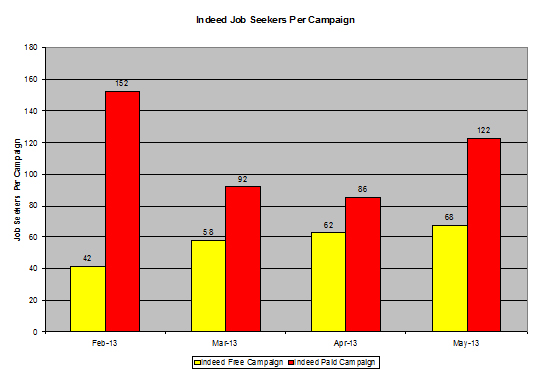
Indeed sponsored ads campaigns attract an average of 113 job seeker views per campaign while organic (free) campaigns attract 57 job seeker views per campaign. This means that a sponsored campaign on Indeed attracts almost twice as many job seekers as organic campaigns.  Here is a graph showing the information for 4 recent months.

Indeed jobs chart

How did we get this information?

(As a recovering nerd I just can’t help but provide the details.)

We track recruitment advertising Return-On-Investment (ROI), so that we can provide our customers with information about how best to spend precious advertising dollars to build a candidate pool. We use Google Analytics, Server logs, and applicant data in NewHire to collect and compile the information we provide.

Here’s the data averaged for February, March, April and May 2013:

Total Active Campaigns

Average

Active Jobs

407

Total Job Seeker Views (traffic)

28454

Total Applicants (all sources)

5563


Indeed Campaigns

Free Campaign Average Paid CampaignAverage
Number of Campaigns

158

45

Total Job Seekers Views (traffic)

9157

4773

Job Seekers per Campaign

57

113


Averages shown are for managed campaigns Feb, March, April and May 2013. Only job seekers from Indeed were considered for this table.

Looking at the Job Seeker traffic, you’ll notice that all the job seekers coming from Indeed only represent a small fraction of our total Job Seeker traffic.

Where does that other candidate traffic come from? For the active jobs discussed here, Indeed is just ONE of many advertising outlets being used to promote each job. Candidates are coming from CareerBuilder, Craigslist, LinkedIn, and the NewHire job board, (and these are just primary sources). For information comparing various job boards’ ROI, visit our previous blog “Top Job Boards of 2013. (/blog/top-job-boards-2013-job-sites-post-job-ad/)

Remember that Job Seeker traffic is also coming from emails and from a myriad of other partner job boards that are re-posting ads. Stay tuned for more updates — over the coming months we’ll continue to explore candidate traffic sources!

http://www.flickr.com/photos/76029035@N02/

Strong interviewing skills can mean the difference between finding your next star employee and making a bad hire. The pressure is on and the interviewer can be as nervous as the interviewee! The interview is your best opportunity to find out if a candidate who looks good through the initial screening process, will be a positive addition to the team. Here is the wisdom gained from more than 20 years of experience interviewing candidates. We learned it the hard way, so you don’t have to.

Before the Interview – Prepare

When the interviewer looks good during the interview the company looks good too, so prepare for the interview and put your best foot forward! Make an interview game plan, and coordinate with everyone who will be interviewing the candidate.

Start by reviewing all available information, including: the candidate’s application, resume, notes from the phone interview and assessment results. Review the job description, too. Next, prepare questions relating to experience, work behaviors, future goals and key accountabilities. Don’t forget to ask questions about significant items like accomplishments, gaps in employment, special skills, leadership activities and hobbies. And remember — some questions are ILLEGAL to ask. Click here for a list of topics that could get you into hot water. Make some notes to use during the interview, especially if you don’t interview very often.

During the Interview — Ask then Listen

Begin with an introduction and a handshake. This sounds obvious, but a warm greeting can go a long way to ratcheting down everyone’s nerves, which will result in more candid responses from the interviewee. Don’t forget to make small talk, ask about the drive to the interview, last night’s unbelievable hail storm, the ball game, or the American Idol competition.

Start the interview using the resume and your notes as a reference. Some interviewers like to ask about every position on the resume. Try it and see what you learn. You might ask the candidate to relate what their supervisor would report as their strengths and weaknesses. This will give you the chance to assess the candidate’s self-awareness, as well as their strengths.

Ask open-ended questions; avoid those that can be answered with a Yes or No. Situational and scenario-based questions are a great tool. Ask questions that begin, “Tell me about a time…” Wait for an answer. Don’t be afraid of silence!

When it’s time to end the interview, ask if the candidate has any additional questions. Be honest and forthcoming about the company and the position as you answer. Surprises can hurt both you and the candidate in the long run. Thank the candidate for their interest and for taking the time to come in for an interview.

Final Thoughts

The goal of an interview is to get an in-depth knowledge about this person’s background and work history, but you are also trying to get a feel for this person’s character, work behaviors and attitudes. Here are some cues and clues to watch for. Does your interviewee:

  • Maintain eye contact and show enthusiasm?
  • Have good communication skills answering questions clearly?
  • Avoid tough questions by changing the subject?
  • Demonstrate respect and friendliness?
  • Pay attention to what you are saying?
  • Use negative language when talking about past employers?
  • Show engagement and interest in the position and the company by asking unscripted questions about what you have said?

Additional resources:
1. An Interviewing Guide: What You Can and Cannot Ask
2. Interview Tips