

Archives For Chuck Smith

6829422155_d895bbb8d3_z

Companies often ask us if it’s true that the best hires come from hiring personal referrals. The answer is — sometimes! According to a New York Times article by Nelson D. Schwartz, employers are increasingly relying on referrals to fill open positions.

In the article, John Sullivan, a human resources consultant states, “Among corporate recruiters random applicants from Internet job sites are sometimes referred to as “Homers,” after the lackadaisical, doughnut-eating Homer Simpson. The most desirable candidates, nicknamed “purple squirrels” because they are so elusive, usually come recommended.”

This is not true! Just because recruiters don’t have a good method for assessing the talent of people who apply online doesn’t make online applicants poor candidates. It just reveals that the hiring company has poor recruiters.

There is no doubt that referred candidates are an extremely important part of the candidate pool. However, substituting a referral for a recruiting process that casts a wide net for all available candidates, screens effectively and identifies the “best available talent” regardless of the source is a mistake.

Relying solely on referrals is both lazy and dangerous. It is lazy because it makes life simpler for recruiters and hiring managers who don’t have a good way to sift through tens or hundreds of possibly more qualified candidates. It is dangerous because people tend to only refer people like themselves. The consequence is that your organization becomes increasing homogenous and less diverse… and this is not only about race or ethnicity. Relying too heavily on a sourcing from referrals is likely to reduce differences in class, education, gender, communication style, behaviors and attitudes that can improve your company.

So, go ahead, reach out for referrals and include them in your recruiting. Just make sure that you don’t short circuit your recruiting process by hiring the wrong person for the job only because they were “referred.” Never hire from a candidate pool of ONE.

What do you think?

As part of our ongoing commitment to offer the best value to our customers, we’re constantly looking for more ways to increase advertising for all NewHire job ads. We’re excited to announce our new partnership with Glassdoor.com, the largest career community on the web, which now publishes all NewHire job ads on their job board. This partnership increases your job ad’s exposure to even more candidates — at no additional cost!

This now marks FOUR carefully selected job boards that all NewHire jobs are published to for free (The NewHire Job Board, Indeed, SimplyHired, and now Glassdoor).

On behalf of the NewHire team, thank you clients for your ongoing business!


You can’t get away with posting a short ad in the local newspaper anymore. Today’s recruiting landscape has so many options out there to help you with your next hire – everything from job ad packs, to software, to fully-outsourced recruiting services. Question is, how do you know which one is right for your company?

I’ve seen the recruiting and hiring landscape change quite a bit in my 24 years of recruiting, but one thing stays the same. Before small and mid-sized businesses start hiring, they need to first evaluate their need. This includes taking a look at the urgency of the hire, how much knowledge/experience they have of hiring, and how much time they have to invest in order to determine the tools they should use. If you don’t have the right tools or sufficient time, your project will probably be doomed to failure.

I put together a little evaluation to help you make a realistic assessment of your organization’s recruiting strengths and weaknesses. Use this recruiting evaluation to rate yourself on the following 5 statements:

  1. Before we start recruiting, we have a concise written statement identifying our target candidate and the impact we expect that person to have on our organization.

Never ………………….. Sometimes …………………… Always

  1. Once we start recruiting, we assign one person the responsibility to see the project through and that person has the time and the know-how to do it right. 
Never ………………….. Sometimes …………………… Always
  1. We know where to go (websites, social media, associations, networks, referrals) to generate sufficient candidates to find the right person for the job. 
Never ………………….. Sometimes …………………… Always
  1. After candidates begin to apply, we have a process to identify the top talent and engage with them within 5 days of their application.

Never ………………….. Sometimes…………………… Always

  1. As the process unfolds we continue to review candidates until we are confident we have the right person for the job, rather than settling for someone we think is “good enough.”
Never ………………….. Sometimes …………………… Always

Congratulations to you if you answered “Always” to all of the above. Using your own internal resources and well-chosen advertising you’ll find the right talent. You may find it even more advantageous to use inexpensive web-based recruiting tools to both advertise your open position and keep track of your candidates. Either way, you’re on the right track.

If you answers were more “mixed,” you should consider taking advantage of additional recruiting resources and outside expertise. For example, you may understand who your target candidate is and have someone in your organization who will recognize that person when they see them, but you may not have the tools and expertise to find the candidates to choose from. You can get help with setting up your recruiting and advertising and do the screening and interviewing yourself. We find that those with mixed answers are great candidates for recruiting services like our Elements and Basic software and service packages.

For those folks whose answers were “Never,” it may be best to get outside help. Though that help may seem expensive upfront, the cost of obtaining recruiting expertise will dwarf the potential costs of hiring on your own. Not only will you waste time and money in figuring out the recruiting yourself, but the likelihood that you hire the wrong person is significantly increased. Nothing is more expensive than hiring the wrong person! We find that businesses that fall here need a full-service recruiting solution like our NewHire Professional package.

What hiring/recruiting processes have you used in the past? How have they worked for your company?

As of April 1, 2012, NewHire no longer provides Monster ads to clients. This brings to an end an 8-year relationship through which we have helped our clients purchase more than 1,600 ads on Monster.

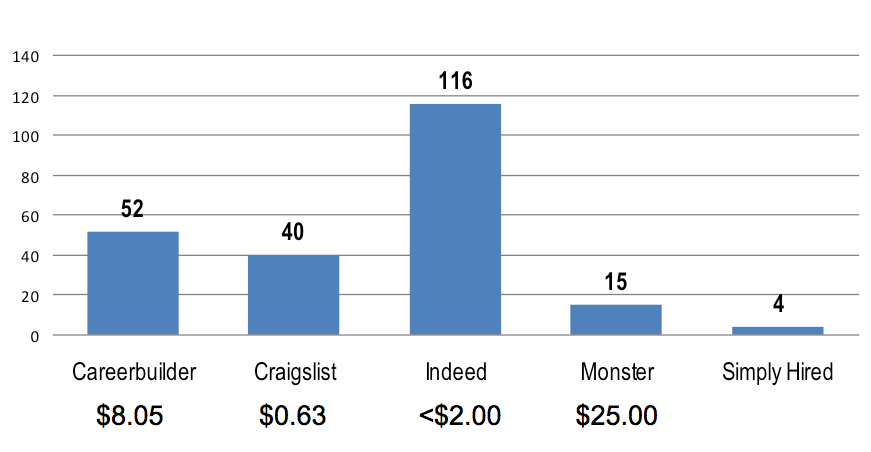
However, our latest data has shown that Monster hasn’t been delivering enough job seekers per ad to justify the cost. The chart below shows the number of Job Seekers per Posting (the number of candidate views generated by each website) and the Average Cost per Job Seeker (the number of candidate views by website divided by the “list” price for one ad on each website).

The chart represents job posting data from 90 open positions from September 2011 to February 2012. The chart also represents the following characteristics:

  • Each position was posted simultaneously on Indeed, Careerbuilder, Monster, Craigslist and SimplyHired
  • The advertised positions represented 15 states, nine industries and four job types
  • Data was compiled from NewHire’s web-logs and verified against Google Analytics

While Indeed and Craigslist yield the most candidates per posting, Careerbuilder continues to be successful delivering a large number of candidate views. SimplyHired is a job aggregator like Indeed, although Indeed is significantly larger. NewHire jobs feed to SimplyHired at no additional charge to our clients, so there is no associated cost-per-candidate.

Indeed, now the most popular job board, attracts the most job seekers, through a combination of no-charge “organic” ads fed to Indeed from NewHire and sponsored cost-per-click ads that feature sponsored jobs prominently on the Indeed job board. We find that Indeed clicks cost employers between 45 cents and $3.00 per click depending on factors like job type and location.

In response to this data, we’ve replaced Monster with LinkedIn job postings to provide our clients the tools to yield the best possible candidate pools.  We’re always keeping careful track and we consider this data when determining the value of our job posting services. We’ll keep you up to date on these results!

We are often asked by business owners and HR managers about how much money they should expect spend on job advertising. They also want to know where they should advertise the  open position(s).

Our President, Chuck Smith, answers these questions at a webinar on best hiring practices for small businesses at EnMast.com, a business owner community. Chuck  talked about each part of the hiring process with Brad Farris, small business advisor and Managing Editor at EnMast.

As Chuck mentioned, Indeed.com is really growing. View our latest findings on the performance for the major job boards.

help wanted

I had the opportunity to attend the Vistage All-City in Chicago, where Brian Beaulieu of IRT Economics did a presentation on the state of the economy and what it means for Small and Mid-sized businesses (SMBs).

During the presentation, he asked the 500+ business owners in the room if they had hired a new employee within the last year. Nearly everyone raised their hand. He then asked those business owners if they’ve had trouble finding candidates. No one put their hand down.

With unemployment so high, why are so many businesses having a hard time getting the right candidates to apply for the job?

Businesses expect a lot of people to apply for their job openings because there are a lot of candidates in the job market – but many businesses owners are saying that’s not the case. Hiring is a pain, and businesses are having a much more difficult time hiring now than ever before. So why is this?


A company’s ability to attract the right candidates depends on the following factors:

  • Location of the job
  • Available talent
  • Relative attractiveness of the position compared to other similar jobs

1. Where is the job located?
If you are a SMB based in Small Town, USA and you’re hiring for a highly skilled job, it’s going to be harder to find someone for the position – you’re fishing in a little pond. On the other hand, if you’re hiring for that same job in NYC, your chances for finding qualified candidates is substantially greater. Location has a lot to do with how many candidates you can source.

2. How much talent is available?
The Wall Street Journal recently published an interactive graphic showing the unemployment rate for hundreds of job titles. The jobs with the highest unemployment rates were in the trades, manufacturing, and construction. The lowest unemployment rates where in the healthcare, petroleum & nuclear engineers, as well as veterinarians. If you are hiring for a job title with a low unemployment rate (like mechanical engineers with a 2.6% unemployment rate) you will have a harder time recruiting and hiring.

3. How attractive is the job?
If you’re hiring for an Engineering Manager Position at your company, your job has to be… well… attractive. You’re competing with other companies for the same (scarce) qualified people. To attract the right talent, you must be able to offer a better (or at least competitive) employment opportunity when compared to similar opportunities at other companies. A better opportunity can include a variety of factors – higher pay, bonuses, extended vacation time, company perks, work environment, or the opportunity for advancement. We recommend that you explore your Employment Value Proposition (EVP) to help you understand what makes your company’s job a stand-out opportunity.

Here’s Your Homework
If you’re hiring for a position at your company, evaluate each of the factors – location, available talent and the relative attractiveness of the job. While you may not be able to impact either of the first two items, you can make the job more attractive and more competitive. Think about alternative incentives and highlight your EVP.

If your job is unattractive – make it attractive! It is worth the extra expense and effort to attract the right candidates. After all – beauty hurts!

I had a chance to attend a discussion with US Supreme Court Justice (retired) John Paul Stevens. Stevens, 91 years old, is the third-longest-serving justice having spent more than three decades on the court. A native Chicagoan and graduate of the University of Chicago in 1941, Stevens proved to be a charming and witty conversationalist. (Here’s a link to the video provided by UChicago).

Of course, I’m no expert in the law. Though, I do claim some expertise in recruiting. So I was interested in Justice Stevens’ answer to a question from a first-year UChicago law student. He asked the justice, “What do you look for in a law clerk?” At 4 clerks per year over the course of 35 years, Justice Stevens had time to form an opinion and his answer to the law student was simple:

“I look for brains, and somebody I’d like to work with.”

My son Max, a first-year undergraduate at the University turned to me and said, “Dad, that’s what you always say… you should put that in your blog.” So here it is and it’s hard to make it much simpler.

If you’ve been worrying that you have been paying employees as contractors, but afraid of the consequences of fessing up, the Internal Revenue Service (IRS) has a new program just for you.

Making use of the carrot-and-stick approach, the IRS has promised small business owners a chance to correct the employment classification of contract employees. At the same time, the IRS is promising to crackdown on mis-classifications with fines, penalties and back taxes.

For a limited time, the IRS will allow an employer to re-classify contractors to employees with about a 1% back tax payment, according to the IRS website. There are certain eligibility requirements that must be met and you should definitely consult with you accountant and employment attorney before applying for the program.

Of course, the issue that most employers face is the ambiguity of the classification process. Who should be a contractor and who should be an employee? Here the IRS is not providing much help. As quoted in today’s Wall Street Journal, below is the IRS guidance on that subject:

There is “no magic or set number of factors that ‘makes’ the worker an employee or an independent contractor.” Here’s a link to the IRS guidance on the subject and good luck…

So it remains up to the employer to decide on the correct classification. Going forward, the IRS promises a crackdown on misclassification, leaving business owners in a familiar, “You can pay me now or pay me later” conundrum. Employees, with their associated costs like payroll taxes, benefits and unemployment costs, are expensive. Independent Contractors are less expensive – unless an employer is found to owe back taxes, insurance, penalties and fines.

This article from the Wall Street Journal serves as an important reminder to employers that their employees’ perspectives matter. More than 75% of “departing employees” say they would not recommend their employer to others,” a 33% increase since 2008.

While helping hundreds of companies hire thousands of employees we’ve learned firsthand what happens when an employer’s reputation is “bad” or their employment “brand” is tarnished. Job candidates know; they find out through the grapevine or read about the company on-line.

Indeed.com has a “forum” section filled with negative comments by employees about specific named employers! Worse yet, there are websites allowing publication of “rants” about jobs and bosses. These “rants” are not edited, reviewed or verified, but they are on the web and can cause you harm.

When former employees speak negatively about their experience, future recruiting is impacted. What looks like a great job to fill on paper, can become very difficult to fill in fact.

Not long ago we worked with a client to fill an operations management job in a manufacturing environment. While we got about 200 candidates for the job, very few were local. The job, in a rural location on the east coast, had great salary and benefits. The job description read well too.

As the recruiting process dragged on, I had a chance to ask a friend who lived and worked in a related industry nearby our client’s plant if he knew anyone to refer for the position. His answer said it all: “No one I know would work there.”

A little more digging revealed that the company suffered from high turnover and low morale. Management tended to be erratic and alienated employees. Everyone is familiar with these work environments and tries to avoid them.

This can become a vicious cycle: poor employers attract poor employees, who bad-mouth the employer (while working at the company and after leaving).

What to do?

Focus on making your place of employment the best it can be for employees. Treat employees with respect at ALL times, but especially when they are departing.

If an employee leaves for a different job, thank them for their service and wish them well in their future. Don’t complain that you trained them and now they’re taking what they know and moving on.

If you must fire an employee, thank them for the service, acknowledge their feelings, sympathize when possible and help them toward their next job as best you can. Don’t yell, threaten, or scold. Don’t engage in a conversation rehashing past problems or reasons for the termination. When possible, ease them out of the position, do what you can to make it an amicable separation. Remember, if the employer is unhappy with the employee, the converse usually applies.

Understand the legal liability around each particular termination situation (and you should always consult an employment attorney). But it is probably more important to ensure that employees, exit with no hard feelings.

Working to build goodwill and a good employment reputation, leads to better employees and happier customers… a virtuous, rather than a vicious, cycle.

If you have specific questions please call or write!

It’s a never-ending debate and a never-ending topic of interest. Who are the best Sales Reps and what characteristics do they share?

I believe that “pleasant persistence” should be a key behavior characteristic in the Sales Reps we hire. How do I define this trait? It is a willingness to engage in repeated interactions with many, many people in a way that communicates that the Sales Rep simultaneously values the prospect’s time and values the product/service the Sales Rep is selling.

This stance contradicts certain conventional wisdom. Many people believe that the best sales people are aggressive and extroverted, often called “Hunters” who eat what they kill. This makes the prospect “game!”

A recent Havard Business Review blog post adds some data to the debate: Seven Personality Traits of Top Salespeople – Steve W. Martin – Harvard Business Review. The result? Modesty and Conscientiousness are the two behavior traits most highly correlated to success in sales.

What do you think of this result?

Now, everyone has their favorite behavior/personality assessments. (Meyers-Brigg, DISC, Devine, Caliper… the list goes on and on) I’ve been exposed to many and find them valuable when used appropriately. Here’s what I consider an appropriate use of behavior assessments. Use them to:

- understand the behavior requirement of the particular position for which you are recruiting
- integrate the identified behaviors into your job description
- assess candidates against the benchmarked behaviors
- engage candidates in a conversation about the behaviors you require
- determine whether or not the candidate models the required behaviors during the entire recruiting process
- say “No” to candidates who don’t match your require profile

Please note that I did not recommend that you use your assessment of choice as a “knockout.” Behavior assessments are NOT math tests. They are not 100% accurate and are best used as guide during the recruiting process.