

Archives For Hiring Trends

Hiring tips and advice for small and mid-sized businesses.

Have You Ever Been Convicted of a Felony?

If you’ve ever applied for a job, you’ve probably been asked this question before. But in many states, this question is going the way of the dodo.

In January 1, 2015, NewHire’s home state of Illinois added its name to the growing list of states with Ban-the-Box; a new legislative practice for employers, Human Resources professionals, and recruiters to be aware of.  To put it simply, Ban-the-Box prohibits employers and recruiters alike from asking about a candidate’s criminal background in the early stages of their application.  This means that all of the job ads out there with a, “Have you ever been convicted of a felony” question, are now considered unfair or discriminatory.Discrimination in Hiring Practices

So what does this mean for hiring processes in 2015?  It means that hiring discrimination laws are tightening to keep candidates from being disenfranchised by their past, or their present, and from getting to the future they deserve.

Hiring discrimination is something all HR professionals and recruiters are acutely aware of, but these rules can be full of pitfalls for organizations hiring without the help of professionals.

All of us are aware of the more obvious areas of hiring discrimination, like race, religion, gender, pregnancy, age, disability, or national origin. However, there are plenty of more obscure discriminatory practices that your business may be using without realizing it.

Ban-the-Box

The newest of these anti-discrimination laws, Ban-the-Box is not yet a federally applied law.  The National Employment Law Project (NELP) has released an informational packet with a map of states that have cities or counties where Ban-the-Box is in effect for 2015.  This law is unfortunately enacted differently in each jurisdiction, however there are some more common applications to aware of when hiring.  As mentioned, employers and recruiters can no longer ask questions about prior convictions in the early stages of the application process, but they also can no longer perform background checks at the early stages, which are now legally reserved for finalist candidates.  The final most common aspect of Ban-the-Box in effect is that background checks are now only required for some positions.  While unfortunately vague, the “some positions” aspect of the law means that you can’t check someone’s credit score unless they are in the final stages of applying for a role that handles money.  Fundamentally it moves all background check or history related questions to the end of the hiring process, allowing candidates experience and personality to avoid an early “knock out” for unfair reasons.

The Genetic Information Nondiscrimination Act of 2008

The most recently enacted and federally applicable discrimination law, known by the acronym GINA, ensures that employers cannot obtain or ask for information regarding applicants’ or employees’, or their family members’, genetics or medical records.  Patton Boggs details that in the case of EEOC V. Fabricut, Inc., among others, that the EEOC sued the employer for allegedly rescinding an offer of employment after a candidate was found to be predisposed to carpel tunnel syndrome after a medical exam required after an offer, where the candidate had to disclose details of their family’s medical history.  A settlement was reached where this candidate received a whopping $50,000 for the unfortunate practices utilized in that specific hiring practice.  GINA protects employees and candidates from being discriminated against on private, inconsequential, and even “potential predispositions to” disorders.

Using Social Media to violate the Civil Rights Act of 1964

Social Media allows us to find out an alarming number of things about people we don’t know. While it’s tempting to browse a candidate’s social media profiles to get a sense for their character, businesses have to be sensitive to the fact that information like race, age, gender, religion, and national origin are also available via these platforms. These are all protected categories under the Civil Rights Act of 1964, which dictate the use of any of these (and some other) categories in making hiring decisions as a violation of federal law and are grounds for legal action.  If hiring discrimination on these grounds is properly proven, this can be a clear infringement of employee/candidate rights.  As Heather Weaver, an attorney with the American Civil Liberties Union, said to the National Journal, “Employers are not allowed to discriminate … whether they do it secretly or openly.”

Arrest Record Discrimination – A less well known and commonly utilized hiring tool

Also covered in Title VII of the Civil Rights Act of 1964 is the inability to make hiring decisions based on arrest records.  As is detailed by the EEOC, “The fact of an arrest does not establish that criminal conduct has occurred, and an exclusion based on an arrest, in itself, is not job related and consistent with business necessity.” While it may be tempting to look up your potential candidate’s arrest records – and let’s face it, we’ve all looked up our neighbors – you can incur a hefty charge for such a discriminatory hiring practice, much like in the case of EEOC V. Fabricut, Inc..  However, the EEOC adds, “an employer may make an employment decision based on the conduct underlying an arrest if the conduct makes the individual unfit for the position in question.”

To help understand this gray area, let’s take for example, a hypothetical employee called Sean.  Sean left work for lunch with friends and had a couple of beers.  An officer pulls him over on his way back to work and asks if Sean has been drinking.  Sean says, “Why yes, officer, but I’ve only had a couple of beers.”  As many of us know, even if you pass a breathalyzer test, but fail the field test (those of us lacking coordination or the ability to say the alphabet backwards will always fail the field test), that you can still be arrested for a DUI.  Even if Sean isn’t convicted, the employer knows that Sean has been drinking during work hours against company policy and could inhibit his ability to function on the job so they are able to terminate his employment.

Wrapping Up – A Good Rule of Thumb to Avoid Hiring Discrimination

In all of your recruiting efforts of 2015, be sure to go on the merits of your employees and candidates, not what you can unearth about them through the archives of information on the internet.  While conducting background checks is an important step in the recruitment process, you can only use that information to inform a position relevant decision, not an all-encompassing, everyone-that-has-a-record-of-anything-is-out type of decision.  Happy Hiring!

FacebookTwitterGoogle+Share

In 2014 Indeed was, once again the biggest winner in the world of Job boards, bringing in 47% of all candidate views and 30% of all NewHire applications for employment. But don’t discount that other 53% of candidate traffic which accounts for roughly 70% of completed applications. This balance of candidate traffic is coming from a combination of other sources, including CareerBuilder, Craigslist, NewHire job board, social media, and array of other smaller job boards. When you’re hiring, don’t miss out on 70% of the possible applicants! Be sure to advertise open positions broadly and take advantage of the power of the internet.

NewHire strives to help our clients make the most of their advertising dollars. For years, we’ve tracked the ability of major job boards to bring candidates to our applications. As we’ve noticed major shifts in job board performance, we’ve adjusted our advertising packages to make use of the most up-and-coming job boards.  Most recently, this has been reflected in changes to our most popular ad package.

We look for ways to maximize the value of recruitment advertising by targeting job boards that yield the most candidate traffic. One of the tools we use to learn about candidate traffic is Google Analytics. As an example, the graph below shows total candidate traffic from all sources at the beginning of the new year.


Analytics Views example_Page_001

We also have the ability to look at an individual job and say, “You have this many applicants, and the most have come from this job board.” We use this information to allocate resources more efficiently. By spending more money where it counts and less money where it doesn’t, we save time and money.

Analytics applies example_Page_01

Looking at individual jobs can be useful, but the sample size is small. Let’s look at the candidate traffic from all of 2014. The following graph shows the percentage of views from each of the major job boards that we use in our advertising packages, plus a job board that one of our bigger clients used extensively.


2014 view rate pi


Views from Job Boards

For 2014 data, with over 500,000 candidate views total, the Indeed job board makes up almost half of the traffic.  Over the last several years, Indeed has steadily increased its presence as a premier job board.  The other substantial pieces of the pie, those labeled  “Direct” and “Other,” are more amalgams. The “Direct” category is a combination of candidates who arrive from certain Craigslist ads in low population areas (where we can’t hyperlink directly to the application). Additionally, candidates arriving from the NewHire job board also appear in the “Direct” category. The “Other” category is from the many smaller job boards that re-post ads. Each one brings in a little bit of traffic but all together they make up nearly 12% of candidate traffic.

CareerBuilder and Craigslist continue to run neck and neck in the views they provide. SimplyHired is a board that one of some  clients have elected directed a lot of traffic in the past few years.  LinkedIn seems to have the smallest piece of the pie here, but there’s a little egg on our face, because some of the 2014 data was temporarily unavailable to us. We are confident that 2015 will show more traffic from LinkedIn.

2014 apply rate pi

Applies from Job Boards

Now – let’s look at applies. The total apply rate for 2014, taken by dividing our total number of views by the number of applicants, is around 15%. Luckily, we can also break down where those applicants originally came from, and get a better idea of how each job board is really performing for us.

With no surprise, out of 86,000 applies, Indeed is still the biggest contributor with around 30%. “Direct” applies are almost equal to those from Indeed.  “Other” applies make up around 15% of the pie, a bigger piece than they grabbed when we look at the candidate Views pie chart. CareerBuilder, Craigslist and LinkedIn also have a strong apply rate, despite their smaller percentage of views. It’s interesting to see that CareerBuilder and Craigslist have a strong showing when it comes to candidate applications, as you can see in the Apply pie chart.

With Indeed grabbing the lion’s share of views and applies, is it worth it to keep advertising on the other job boards? Should we just put all our money into Indeed? The answer, in short, is no. We can also look at a job board’s applies as a subset of the number of views from that board, and we can figure out what a job board’s individual apply rate is.

For example – CareerBuilder had 9,228 applies in 2014, out of 23,757 views. That gives it an apply rate of 38.84%. That means almost 40% of people who saw a job from NewHire  on CareerBuilder went through our process and filled out an application! This is great when compared to the average apply rate, which is 15%. The graph below shows the apply rate of the major job boards.


2014 job board applies average

Indeed, which dominates both views and applies,  only has a 10% apply rate, which means a lot of people look at our posting on Indeed, but don’t actually apply.  CareerBuilder, Craigslist and LinkedIn, on the other hand, show 30-40% apply rates. Other and Direct  are also important sources of candidate applications.

So – what does this mean for you?

  • Your job should be advertised on multiple job boards to take advantage of the Direct and Other categories. Candidates search for jobs on many different smaller and larger boards.

  • You should make sure your job is on Indeed, because it’s the biggest board out there right now.

  • Don’t forget to share your job on social media and throughout your network, LinkedIn, Twitter or Facebook, which ever you use. “Other” makes up for a large portion of the application pie.

  • The most popular job boards are never a constant. What is producing good results now could be in a decline six months from now. To stay up to date and to receive our initial 2015 data later in the year, be sure to subscribe to NewHire’s blog and email list!

The coming year will be a challenging year for finding the talent you need to grow your business. This is not a prediction. It is the current reality and it is not likely to change in the next 12 months. Employers have had it easy for a few years now, taking advantage of large pools of candidates and little wage growth. New realities require new strategies and tactics. They require smart hiring solutions. Want to know how to be prepared?

Here are four trends and hiring solutions that will help you hire better in 2015. 

1. More jobs available

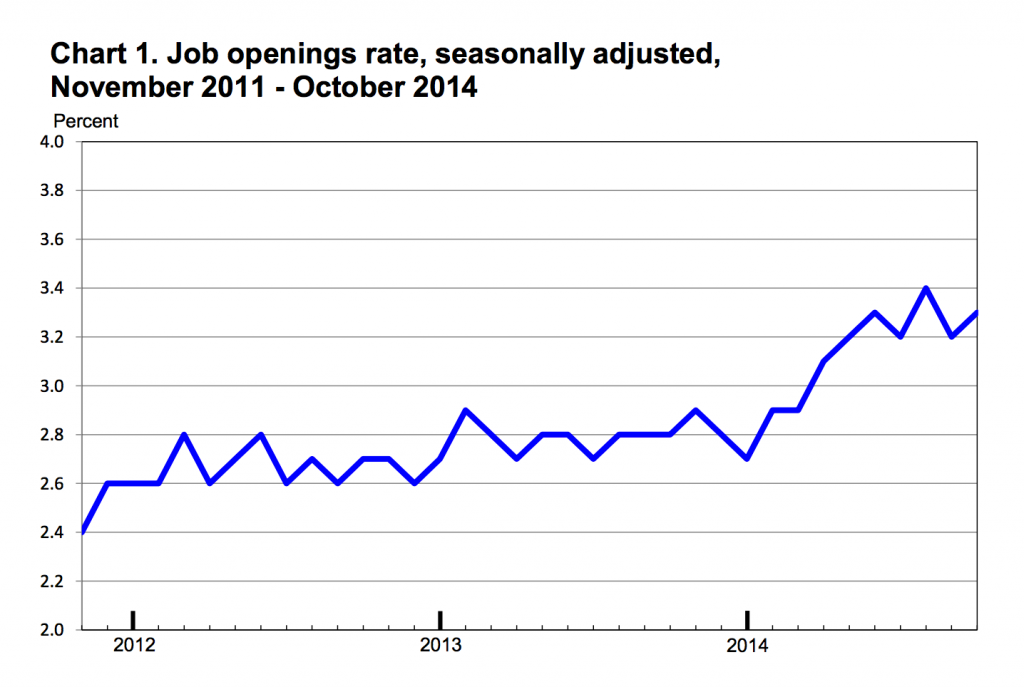
Look at the most recent chart from the Bureau of Labor Statistics. You don’t have to be a math whiz to see the upward trend in available jobs:

Hiring Trends for 2015: Job availability will increase

Small and mid-sized businesses looking to hire staff face nearly double the competition. Just this week, three candidates (two for a client and one for us) canceled their interviews the morning of, saying that they had taken full-time jobs.

In order to get the talent you need, your recruiting is going to have to be both slower and faster.

By slower I mean: you must plan further in advance, start recruiting well before you need a person to start, and expect the process to take longer than before. By faster I mean: you must review candidates more quickly, move through the interview process with dispatch, and make offers without dilly-dallying. Expect candidates to negotiate for more money, benefits, and flexibility.

2. Increased willingness of your employees to change jobs

For most industries and most geographies, business has been steadily improving since 2012. Employers and employees have taken some time to modify their bunker mentality, but the change has come. Your employees are looking for opportunities to “learn more, earn more and do more.” If they don’t get those opportunities from you, they’ll get them from another employer.

At a minimum, you must complete employee reviews. Think about whom you must retain, who you’d prefer to keep, and who you’re okay with letting go. Spend your time with employees in that order.

If you’re thinking about strategies or tactics to keep employees happy, make sure that what you do aligns with what they want. Knowing your employees’ natural motivations allows you to create rewards customized to their wants. For instance, creating a bonus plan for a person who would prefer to take an enrichment course may be ineffective.

3. Perceived and real skills gaps

My favorite Rolling Stones song says it best:  “You can’t always get what you want, but if you try, sometimes you get what you need.”

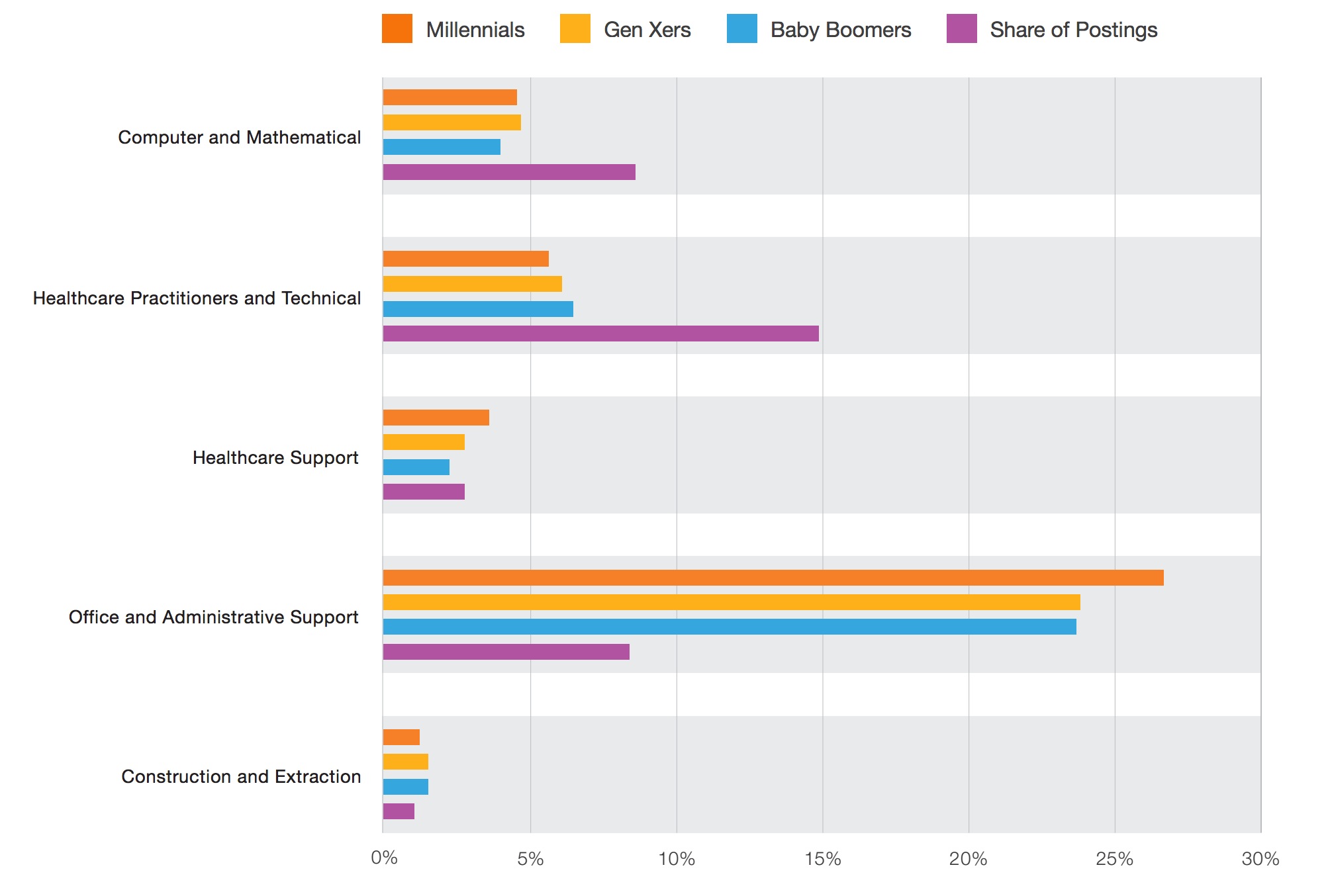
Manufacturing operations, IT support, software development, Healthcare practitioners and technicians, and almost all kinds of sales representatives… these employment categories have many more openings than they have qualified candidates. Just because you NEED to hire these people doesn’t mean that you can. The chart below compiled by Indeed.com shows the number of available jobs in purple and the potential applicants by generation. Note the gap in technical and healthcare and the over-abundance of administrative candidates.

Job Trends 2015: Skills Gap


Bidding wars are breaking out for the talented and experienced. Signing bonuses are common in IT. SMBs can’t compete on compensation with larger companies. What can your business do to combat this problem?

Make peace with the idea that you will be hiring more junior people and training them. Some will stay and some will move on, but it will work out if you’ve built the idea into a long range plan. Your advantage will be a larger pool of talented candidates who have aptitude and desire without experience. You’ll be able to afford to invest in them.

4. Accelerating Boomer retirements

The retiring Baby Boomer is exacerbating the skill gap trend. According to FiveThiryEight.com’s Ben Casselman, “In 2003, 82 percent of boomers were part of the labor force; a decade later, that number has declined to 66 percent, and it will only continue to fall.”  This trend has many far-reaching consequences that we don’t have the space or time to address here.

However, when it comes to employment issues, here’s one important fact:  Skilled Baby Boomers will take an immense body of knowledge with them into retirement. Employers must actively facilitate the knowledge transfer from Boomers to GenXer’s and Millenials.

A large number of our clients are facing the need to replace retiring Boomers. Make sure you allocate enough time to identify, hire and train new people. Wait too long and you may face critical failures in your operation.

The War for Talent is back in full force. What are your predictions for hiring trends for 2015? What hiring solutions will you employ to win the battle?


Maybe you have seen them while prowling around Internet job boards. I call them “Do Not Enter” ads. They are job advertisements that focus on turning away unqualified candidates instead of luring in qualified candidates. Postings with this type of job ad jargon meant to keep candidates away are everywhere.

Whether by habit or another reason entirely, hiring managers still use job application jargon to keep certain candidates from applying. The main focus should be on getting the right candidate in the door, not keeping candidates away. They use jargon that is specific to their workplace, “need not apply” statements, and other fence-building tactics to keep unqualified candidates out.

I understand the logic here. If only qualified candidates apply, a hiring manager only has to sort through resumes and applications that deserve attention. But at what cost? Is it possible that the right candidate – the person who is the most perfect fit for your job – is also being turned off by that job-specific jargon?

Shouldn’t we be more focused on attracting the right candidate than turning away the wrong ones?

job ads jargon turns away candidates

Luckily, in a tech-world, there is a technological solution. Applicant tracking systems have made sorting through your candidates as easy as a click of a mouse. Modern technology alleviates the concern that you may have to filter through hundreds of resumes. With online job applications, resumes are a thing of the past. Tossing out resumes and using modern ATS technology will allow us to make the best possible hire for our companies by luring in the right candidates and sorting out the wrong ones quickly. Not turning them away, but rather sorting them out.

Ultimately, hiring is about one important thing: finding the right candidate for your job. We believe there is a special candidate out there for every job. And in an era of simple online applications, those candidates are trying to figure out quickly whether they can perform the tasks described in an ad. If your ad is full of jargon, the likelihood is much higher that it will be ignored, and the right candidate for your job will be out of your line of vision.

Open the gates!

If you are stuck between discouraging unqualified candidates and avoiding blocking the candidate from applying, the choice is simple. Open the gates and let as many candidates in as possible. By searching key points in an online application, an employer can save time and money that would have been spent reading through resumes. Then, more time can be spent on the four or five candidates most likely to be the one.

So go back and take a look at your most recent job advertisement. Did it use jargon? Were you focused on making sure certain candidates didn’t apply? Take the “need not apply” statements out of your job description and replace them with statements that get candidates excited to apply.

Give job seekers a few sentences to let them know whether your job is one they would like to work in or not. If I’m a job seeker, what four or five things will I be doing on a daily basis that will add value to the company? What is your company all about? What makes it a great place for me to work? And what tangible things qualify me or disqualify me from competing for this job? Answer those 4 questions in a way that’s easy to understand, and your job advertisement will get you more qualified candidates.

Using technology, the application sorting process is easier, and by extension, the application writing process is easier. Now all your focus can be on attracting the right candidate to apply, which is the best way to get the ideal employee for your company.

Mad computer

In the digital age, consumers have more information available than ever before. One increasingly popular source for such information is opinion and review platforms with non-professional/user-generated content. Whether it’s ranking a restaurant (Yelp), movie (IMDb), book (Goodreads), or even college professor (RateMyProfessor), it has become more and more frequent for everything and everyone to fall under anonymous Internet raters’ scrutiny.

And while much has been written about employers’ ability to use social media to check candidates’ backgrounds, the web has also enabled job seekers to research prospective employers based on past and current employees’ reviews. These employer reviews can play a major impact on the recruiting process, whether positive or negative, and are becoming increasingly important to track when looking to a make a hire.

Where are jobseekers going for Employer Reviews?

The two largest employer review websites currently are Glassdoor and Indeed. While smaller employers could have zero to a few dozen reviews, large employers, such as Coca-Cola, have over a thousand. On both sites, current and former employees rate companies on a 1 to 5 star scale.

Glassdoor allows reviewers to get a little more specific and asks reviewers to rate companies’ Culture & Values, Work/Life Balance, Senior Management, Compensation & Benefits, and Career Opportunities. Both sites allow reviewers to leave comments to accompany their rating, which is frequently where the most insightful information resides.

When a possible applicant uses these sites to research an employer and sees an overwhelming number of negative comments, their desire to spend time applying for that position shrinks. No one wants to work for a bad employer.

Do these reviews really have an effect on recruiting?

How frequently have you seen a restaurant proudly displaying their high Yelp or TripAdvisor rank? Some service sites put enough credence in user reviews that they use them for quality assurance.

For example, Uber, an increasingly popular transportation start-up does not allow drivers who fall below 4.7 stars to continue to drive under the company name. While goods and services providers have known for a while that online review sites affect business, when it comes to recruiting, many small- to mid-sized companies may overlook online reviews’ influence on attracting applicants and hiring people to fill positions.

When consumers turn into candidates, they don’t stop utilizing the web for information gathering. Time Magazine reported that nearly half of employees polled in 2013 said that a company’s online reputation matters as much as the job offer.  For personal evidence- all three of the most recent employees at NewHire (myself included) looked at online employer reviews during our job hunt. Finally, one possible extra perk keeping high reviews: saving money. Most candidates are willing to accept a lower salary if company reviews are favorable.

In their 2013 Candidate Behavior Study, CareerBuilder discovered that 67% of the over 5,500 job seekers polled said they would take a lower salary at an exceptionally reviewed employer online. That’s a lot of people.

Employer reviews are key to making good hires at the rate you want. So now that you know how important they are, what can you do about poor reviews? Stay tuned for part 2 and I’ll let you know.

Today’s jobseeker landscape has vastly changed from how it appeared only a few short years ago. Job boards like HotJobs and Monster.com have all but disappeared from our regular referral sources, while new boards like Indeed have exploded in usage. Job seekers tend to sway in what boards they favor like teenage girls to the newest boy bands; what was trendy four years ago is no longer “in” and what is popular now might not be in the future. The importance of social media as a source for jobs seekers is reflected in LinkedIn’s steady presence on our lists of preferred referrers.

During the past four years, Indeed experienced explosive growth, nearly doubling the number of annual job-seeker views per NewHire job since 2010. CareerBuilder and Craigslist have declined steadily. And for the first time ever in 2013, Craigslist edged out CareerBuilder. LinkedIn remains a very steady board, providing a stable number of job- seeker views to NewHire jobs each year.

CareerbuilderG1ReferralsPerJob-1- Large Key

In 2010 CareerBuilder was the top performing job board with Craigslist in a clear second place. Today the lay of the land in recruitment advertising is changed. Indeed is the clear winner.

But there are other players that can’t be ignored. In second place, receiving the silver medal, is a category we call “other”. It is made up of 100s of Niche job boards, employer careers pages, emailed jobs and Google searches. This category is like the relay team – energizing the recruiting landscape with many less well known players. Together these sites play a key roll in attracting candidates. Is next year’s big winner hiding in this category? We don’t know, but stay tuned because as surely as daffodils bloom in spring, the recruitment advertising market will change in the coming four years.NicheJobBoards_NumberOfBoardsPerYear

The rise of these niche job boards is part of the reason why things are not completely doom and gloom for CareerBuilder. While it may not contribute as many candidates as Indeed, it does play an important part in the “spider web” effect of spreading posted jobs to its partner sites such as Headhunter and MoneyJobs. Combined with our highest application rate of 38%, there are still compelling reasons to keep CareerBuilder a part of your recruiting process.

More about the data and how we get it:

As a provider of applicant tracking software and recruitment advertising services to companies with 1000 or fewer employees, NewHire is in a unique position to provide independent data on job board performance.

In the past, we’ve blogged about the importance of Indeed as a source for candidates – the people who actually apply for the job, not just job seeker views. In the data shown here we’ve expanded– going back four years – to get a more general look at how both Indeed has risen up – and CareerBuilder and Craigslist have tumbled.

Below is a table showing the detailed results of this four year effort.

table info reformatted_ecantave

First – let’s look at the number of unique NewHire jobs each year that received views from key job boards including CareerBuilder, Craigslist, Indeed and LinkedIn. We’ve also included the category of “Other” as a catch all for many smaller niche boards and our own NewHire Job board. Every NewHire job with a job-seeker page view sent by one of these boards was counted.

As the employment market has steadily gained steam, you can see the number of jobs advertised on each board has steadily increased.

So, with increasing number of jobs advertised, you might think our referral numbers also show a corresponding increase, correct? Not according to the data we examined. CareerBuilder shows a small gain before sliding in 2012. Craigslist, on the other hand, rises through 2012 and then falls off in 2013, while Indeed explodes in popularity, growing each year. The only job board to actually follow the pattern we expected is LinkedIn, which showed modest increases in traffic each year as more jobs were added. Finally, the last column of the table shows the annual number of referrers per job. CareerBuilder and Craigslist lost the most ground, and Indeed gained the most over the past four years.

What does this really say about Job Board performance?
• Make sure your job is featured on Indeed
• Don’t discount advertising on other boards as they bring views, candidates, and links that all help drive the category called “other”.
• Take advantage of the interconnectivity of the web and social media sharing to help us help you get the right candidates!

Stay tuned as we delve further into that mysterious “Other” category in future blogs!

iStock_000009016865Small

Sometimes you have to jump into that new millennium (+14 years) and embrace the breakthroughs that are at your fingertips. There’s a reason CD players, Napster, and M. Night Shyamalan were all mercifully put down like rabid raccoons. Progress and innovation have rendered them all obsolete. The role of the resume as the central piece to the hiring process is on that same path. You have other tools at your disposal to identify the best candidates for your job besides the resume. So if your recruitment process still begins and ends with the resume, then you’re doing it wrong.


Resumes ignore personality fit:

All employees are not created equally; different employees thrive in different environments. Some employees do better when they’re allowed more autonomy; others do better when they have a set routine to follow. Some are better at working on one thing at a time; others are great at multi-tasking. Resumes give you no insight into an applicant’s personality, which means you have no insight into how your position matches up with their strengths, priorities, or optimal working conditions. If you want to set an employee up to succeed, then you should make sure that whomever you bring on has the right personality to match the position.


Resumes ignore culture fit:

Matching the personality of an employee with the culture of your company is as important as matching their skills to the requirements of the position. An employee whose values are not aligned with the company’s values runs the risk of hurting morale or distracting the team from reaching common goals. If a resume can’t tell you that an applicant plays well with others, then that resume is leaving out a valuable piece of information that can determine how successful a new employee will be at your company.


Resumes ignore motivators:

Work is more than a place we go to earn money. Today’s workers are looking for reasons beyond a paycheck to commit themselves to their job, and resumes are a poor tool for uncovering what those motivators could be. Motivators — like mastery, autonomy, and purpose — are strongly correlated to job satisfaction and engagement, which in turn are strongly correlated to productivity. If you want to get the most bang for your buck, then you should figure out what the motivators for your top candidates are. The right candidate is the one whose motivators overlap with what the position offers.


Resumes ignore YOU:

You are the most valuable source for judging a qualified candidate. You know exactly what skills and experience a successful hire will need to do the job well; applicants don’t. Resumes end up being a long list of skills that were useful in their past positions or strengths they feel they can bring to any job. Now you’re stuck guessing if the skills and experience an applicant listed would be a good fit for your position when you should be evaluating those candidates based on criteria you know are essential. Stop relying on industry standards and guesswork to figure out if a candidate is the right one for your company. Customize the recruitment process to answer the questions that you know need to be asked.

Resumes have been a standard part of the recruitment process for a long time. They still have a place in the recruitment process, but their importance has been mitigated by the introduction of new methods of evaluating applicants. Relying on resumes is like relying on hammers to fix everything in your kitchen. Both are just one tool in your arsenal, and sometimes they aren’t even the best tool to get the job done.

Have you ever been frustrated by the lack of qualified candidates for your position? Especially since the market has been seen as an employer’s market for many years now? Many clients we work with can be surprised that every job posting is not flush with candidates.

This is because the market is changing, and many industries and companies are finding it more and more difficult to find the right candidates. Here are some of the major reasons candidates are getting scarce:

Specialized jobs are not an employer’s market

As many software companies can attest, finding software engineers at all levels has been a challenge for quite a while.  Other specialized industries are starting to come across the same problems, specifically, the manufacturing industry. According to an article by Ere, more than 50% of manufacturing managers have already experienced difficulty in finding the skilled labor for their production floor.

Unemployment is decreasing

Since 2010, according to the Department of Labor, unemployment has been decreasing steadily from 10% to 7%. Across all sectors, talent is becoming more and more difficult to find as the job market improves.

Department of Labor-3


More companies are hiring, and competing for the best candidates.

As the economy gets better, and the candidates get more difficult to find, there is going to be an increased competition for the best talent. Simple as it may sound, many companies don’t realize that if you’re hiring… other companies are probably hiring as well.

What can you do to get the best candidates?

So what can you do to find the best candidate? First, you need to advertise more and everywhere. Looking at our previous blog, “Why You Need Multiple Job Boards”  you can see that more advertising in a variety of places will bring in more candidates.  Second, offer a good employee value proposition (EVP). What EVP means is to give candidates a reason to apply to your job advertisement e.g. a great salary, flexible work hours, or a heath club membership.  All these things will help entice a candidate to apply to your position.  Take a look at our other blogs, for more specific tips on increasing your candidate pool.


Check out our new cartoon!

NewHire and Goldie

http://www.flickr.com/photos/76029035@N02/

You might have heard one of our sales professionals or staffing coordinators answer: It depends on the relative attractiveness of the job and the relative scarcity of candidates. While it might sound like something from a freshman economics class, it’s the truth.

When employers request our NewHire Professional full-service recruiting solution, we gather information on the time-to-hire by industry and by job type. Of more than 100 positions filled using NewHire Professional,

  • 15 were Accounting positions (or related financial fields),
  • 28 were Management positions,
  • 22 were Administrative positions,
  • 25 were Sales positions,
  • 15 were IT positions,
  • 5 were Engineering positions, and
  • 2 were Draftsmen positions.

On average, we filled these positions in 65 calendar days.

What can you do to make any hire a smooth and efficient hire?

Manage Your Own Expectations

When we help hire for an industry with near full employment, such as insurance or civil engineering, expect the average fill time to double, regardless of the type of position being filled. But when we recruit for administrative personnel, expect to fill the job much more rapidly in 35 or so days.

Moral of the story? Your industry will ultimately determine how quickly you can hire. If you are in the unfortunate position of needing to hire scarce candidates, do everything you can to make your opportunity more attractive.

Make Your Opportunity More Attractive

Naturally, an employer could attract more candidates by offering a higher salary than the competition, offering tuition reimbursement, providing an extra week of vacation each year, or offering more perks than a candidate can count on two hands. All of these are excellent strategies, but if you’re like many employers, you don’t have extra money/perks to throw at candidates. In that case, be creative (yet honest) when making your job more attractive than the next.

Employ any of these strategies and you’ll soon be employing your potential hires as quickly as possible:

  • Express to your candidates how great it is to live/work in your city/state.
  • Explicitly describe what sets you apart from other companies in the industry. Is it your product line? Your office environment? Your commitment to the community?
  • Give an insight into what separates your corporate culture from other companies.
  • Advertise in creative ways and in creative places.