Archives For Eric Hawrysz

When most companies recruit, they focus on casting a wide net to get as many candidates as possible, often getting many unqualified candidates in the process. By focusing on a few key pre-recruiting tasks, you can start with a better pool of candidates – and find that one person you’re looking for easier.

5 Things Every Company Should Do Before Recruiting

1. Know the position you’re hiring for

It cannot be stressed enough that to get qualified candidates, you need an informative description of the job that can be advertised out to the world. Having a good handle on what the duties of the job you’re recruiting for, and the salary level, will help you immeasurably in figuring out what qualifications you’re looking for in candidates.

2. Know your company culture

Keep in mind what kind of company you are when looking for new people, so you can look for the right fit in your candidates. Are you a tech start-up with a very loose business culture? Or are you a big corporation with strict guidelines for everything? Are you looking for strict compliance employees or mavericks who will get the job done by any means necessary? Figuring out who you are helps figure out who you need to look for.

3. Know what your company has to offer as incentives to bring people in

So many companies advertise out their jobs and wonder why no one applies. And so many of them only list what they need and not what the company can offer candidates aside from a steady salary. Be aware of what benefits there ware for working at your company, whether they’re direct incentives to employees (Health Insurance, 401(k), Paid Time Off, etc…) or indirect incentives of the job/industry/location (cafeteria, free coffee, free promotional materials or products, etc…) putting some type of Employee Value Proposition in your job ad will help you find motivated candidates.

4. Find out what the public and your current and former employees think about your company

A recent phenomenon we’ve noticed here at NewHire has been the proliferation of Company reviews on social media. Sites such as Glassdoor offer people a forum to say what’s on their mind, whether good or bad. Companies should make an effort to see if they’ve been reviewed and to deal with any bad reviews in a tactful and constructive manner, because you can be sure in this internet-savvy world, your potential candidates are looking at those same reviews as they’re weighing whether or not to apply.

5. Have a seasoned interviewer

Whether you have an HR department in your company, or you contract out your recruiting to an outside agency, whoever is actively interviewing your candidates should have an idea of the previous four points to accurately rate the candidates who make it past the “looks good on paper” stage. Your interviewer should be able to tell in a short amount of time whether the candidates you’re looking at are a good fit for the company.

FacebookTwitterGoogle+Share

In 2014 Indeed was, once again the biggest winner in the world of Job boards, bringing in 47% of all candidate views and 30% of all NewHire applications for employment. But don’t discount that other 53% of candidate traffic which accounts for roughly 70% of completed applications. This balance of candidate traffic is coming from a combination of other sources, including CareerBuilder, Craigslist, NewHire job board, social media, and array of other smaller job boards. When you’re hiring, don’t miss out on 70% of the possible applicants! Be sure to advertise open positions broadly and take advantage of the power of the internet.

NewHire strives to help our clients make the most of their advertising dollars. For years, we’ve tracked the ability of major job boards to bring candidates to our applications. As we’ve noticed major shifts in job board performance, we’ve adjusted our advertising packages to make use of the most up-and-coming job boards.  Most recently, this has been reflected in changes to our most popular ad package.

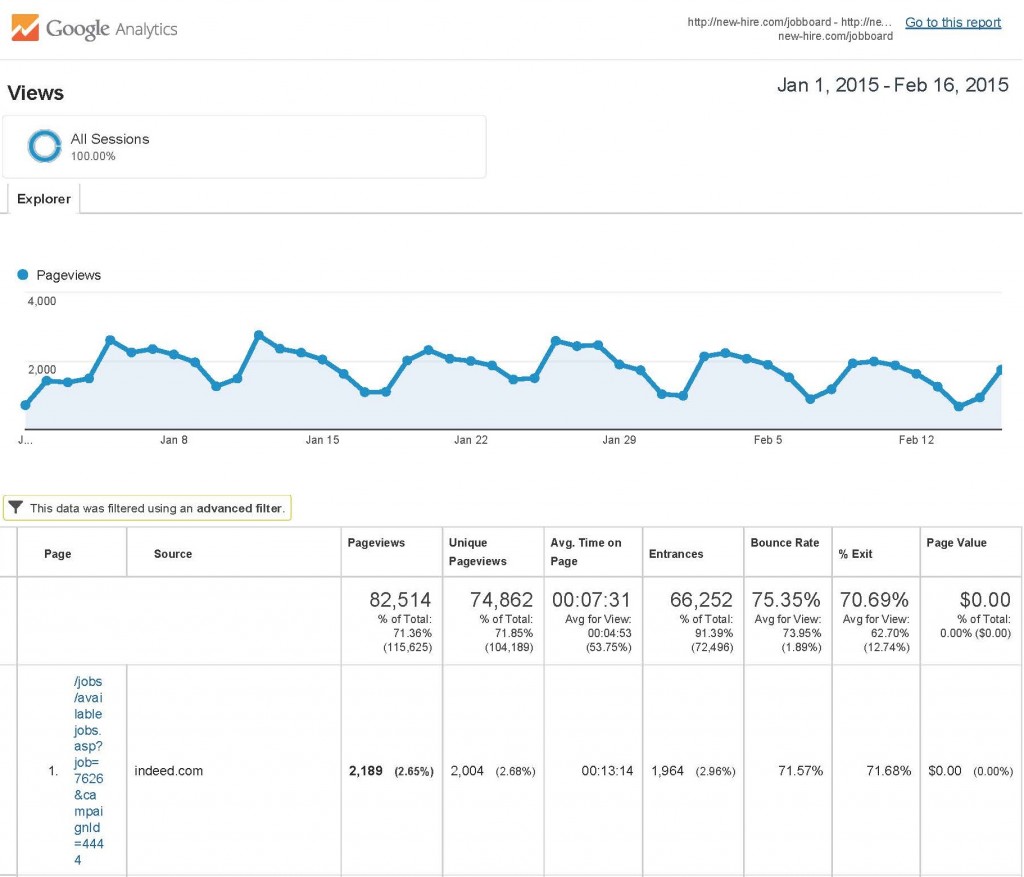
We look for ways to maximize the value of recruitment advertising by targeting job boards that yield the most candidate traffic. One of the tools we use to learn about candidate traffic is Google Analytics. As an example, the graph below shows total candidate traffic from all sources at the beginning of the new year.
 

Analytics Views example_Page_001

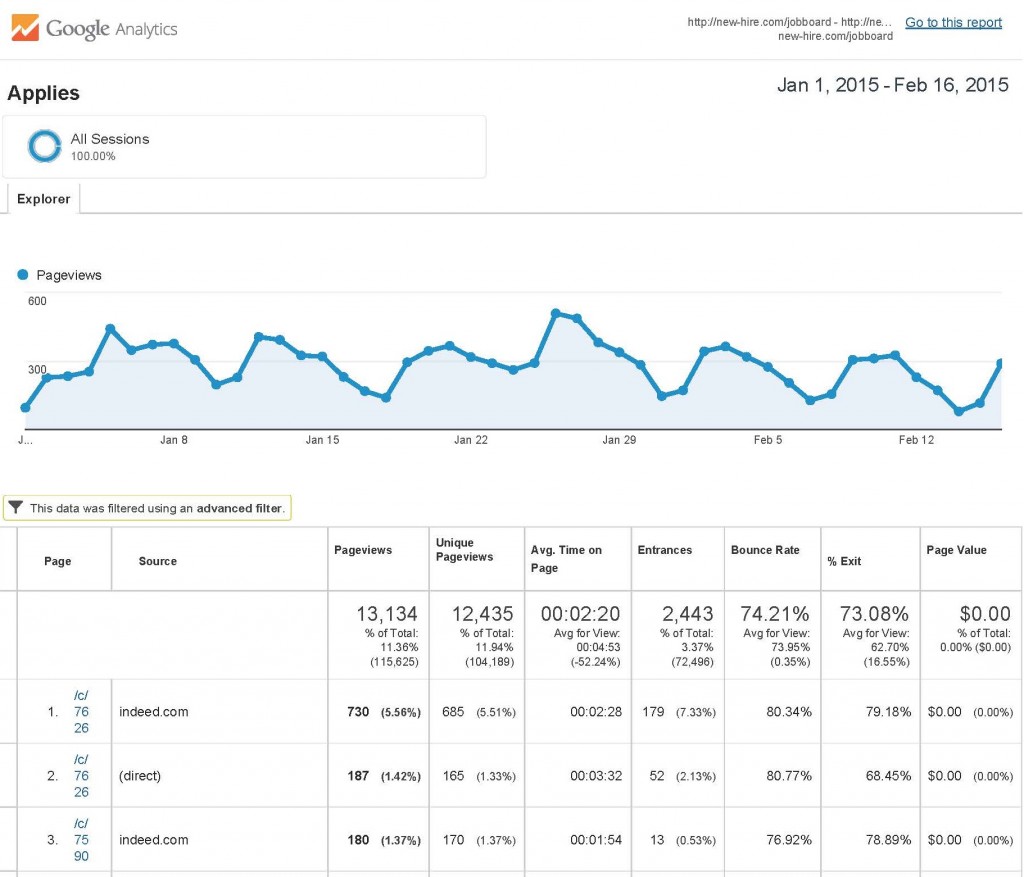
We also have the ability to look at an individual job and say, “You have this many applicants, and the most have come from this job board.” We use this information to allocate resources more efficiently. By spending more money where it counts and less money where it doesn’t, we save time and money.
Analytics applies example_Page_01

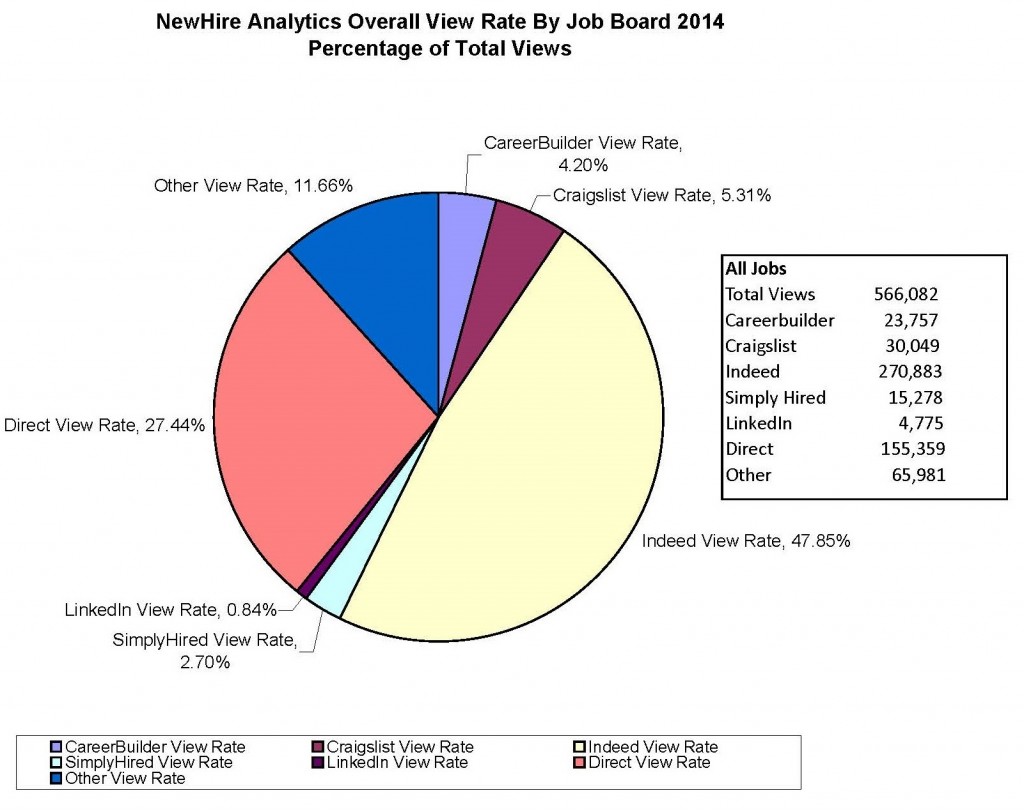
Looking at individual jobs can be useful, but the sample size is small. Let’s look at the candidate traffic from all of 2014. The following graph shows the percentage of views from each of the major job boards that we use in our advertising packages, plus a job board that one of our bigger clients used extensively.
 

2014 view rate pi


Views from Job Boards

For 2014 data, with over 500,000 candidate views total, the Indeed job board makes up almost half of the traffic.  Over the last several years, Indeed has steadily increased its presence as a premier job board.  The other substantial pieces of the pie, those labeled  “Direct” and “Other,” are more amalgams. The “Direct” category is a combination of candidates who arrive from certain Craigslist ads in low population areas (where we can’t hyperlink directly to the application). Additionally, candidates arriving from the NewHire job board also appear in the “Direct” category. The “Other” category is from the many smaller job boards that re-post ads. Each one brings in a little bit of traffic but all together they make up nearly 12% of candidate traffic.

CareerBuilder and Craigslist continue to run neck and neck in the views they provide. SimplyHired is a board that one of some  clients have elected directed a lot of traffic in the past few years.  LinkedIn seems to have the smallest piece of the pie here, but there’s a little egg on our face, because some of the 2014 data was temporarily unavailable to us. We are confident that 2015 will show more traffic from LinkedIn.
2014 apply rate pi

Applies from Job Boards

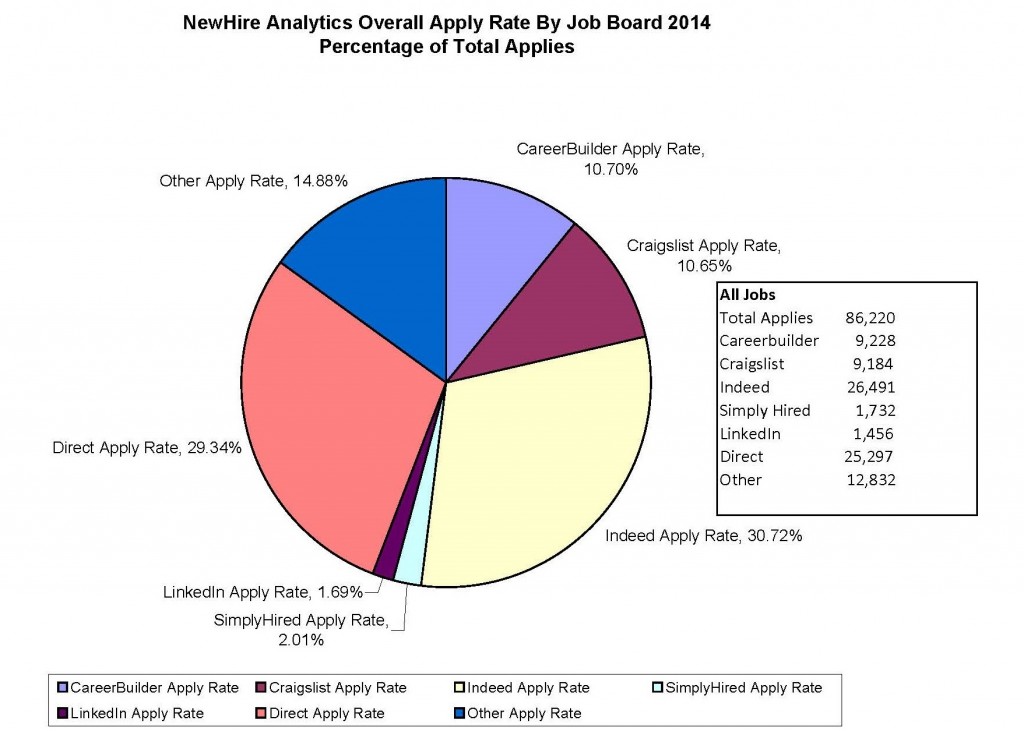
Now – let’s look at applies. The total apply rate for 2014, taken by dividing our total number of views by the number of applicants, is around 15%. Luckily, we can also break down where those applicants originally came from, and get a better idea of how each job board is really performing for us.

With no surprise, out of 86,000 applies, Indeed is still the biggest contributor with around 30%. “Direct” applies are almost equal to those from Indeed.  “Other” applies make up around 15% of the pie, a bigger piece than they grabbed when we look at the candidate Views pie chart. CareerBuilder, Craigslist and LinkedIn also have a strong apply rate, despite their smaller percentage of views. It’s interesting to see that CareerBuilder and Craigslist have a strong showing when it comes to candidate applications, as you can see in the Apply pie chart.

With Indeed grabbing the lion’s share of views and applies, is it worth it to keep advertising on the other job boards? Should we just put all our money into Indeed? The answer, in short, is no. We can also look at a job board’s applies as a subset of the number of views from that board, and we can figure out what a job board’s individual apply rate is.

For example – CareerBuilder had 9,228 applies in 2014, out of 23,757 views. That gives it an apply rate of 38.84%. That means almost 40% of people who saw a job from NewHire  on CareerBuilder went through our process and filled out an application! This is great when compared to the average apply rate, which is 15%. The graph below shows the apply rate of the major job boards.
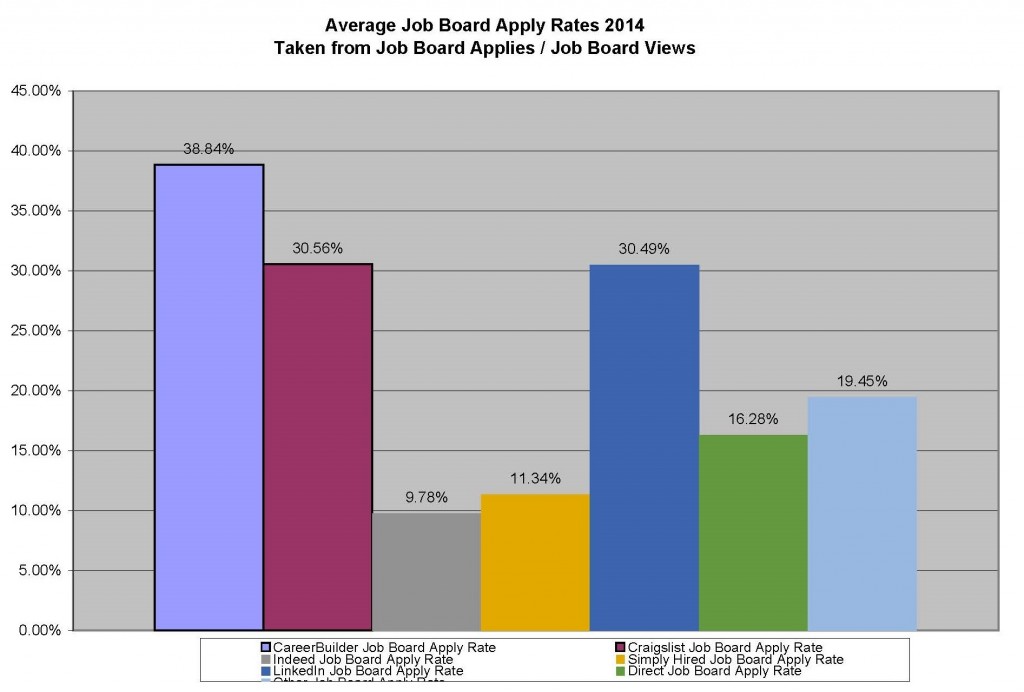
 

2014 job board applies average

Indeed, which dominates both views and applies,  only has a 10% apply rate, which means a lot of people look at our posting on Indeed, but don’t actually apply.  CareerBuilder, Craigslist and LinkedIn, on the other hand, show 30-40% apply rates. Other and Direct  are also important sources of candidate applications.

So – what does this mean for you?

  • Your job should be advertised on multiple job boards to take advantage of the Direct and Other categories. Candidates search for jobs on many different smaller and larger boards.

  • You should make sure your job is on Indeed, because it’s the biggest board out there right now.

  • Don’t forget to share your job on social media and throughout your network, LinkedIn, Twitter or Facebook, which ever you use. “Other” makes up for a large portion of the application pie.

  • The most popular job boards are never a constant. What is producing good results now could be in a decline six months from now. To stay up to date and to receive our initial 2015 data later in the year, be sure to subscribe to NewHire’s blog and email list!


You have your foot in the door with a great company and have scheduled an interview. You want to make a great impression, but as you look through your wardrobe, one question remains: “What do I wear?”

Now, before you run out and purchase an entirely new wardrobe just for the interview (Admit it. You were considering it). It’s important to take a moment to consider a few key points. Below are some great strategies on how to dress for an interview and land your dream job.

First, think about where you’re interviewing. How to dress for an interview is often defined by company culture. There is a general rule of thumb that dictates, when on an interview, your attire should be a level up from the company’s general dress code. For example, an interview with a casual startup warrants, at minimum, business casual clothing. Likewise, for an interview at a company with a business casual dress code, you should wear business professional attire. If you don’t know your interviewer’s dress code, take this as a perfect opportunity to research or inquire about it! Taking the initiative to ask a prospective employer questions will not negatively impact your job search.

How To Dress For an Interview

With that being said, what is “business casual” exactly? Think khaki pants, dresses, slacks and skirts.  Polo shirts, cotton shirts, and sweaters are all considered acceptable business casual tops with ties generally deemed as optional. Conversely, professional attire tends to take the form of a crisp, tailored suit for men and women alike.

Once you have an idea of how fancy you need to dress, now is the time to begin searching through your closet. It’s best practice to keep your staple interview pieces neutral. Navy blue and gray are great go-to colors when it comes to blazers, suits and skirts. A classic white shirt or blouse is always a safe bet. However, if you’re looking to make more of an impact, colored tops are viable options as long as they coordinate well and don’t clash with the rest of your outfit.

When it comes to footwear, leather shoes are preferable for men, whereas simple heels are a solid option for women. Regardless of your interview garb, the goal is to have the focus on YOU, and not your clothes. Hair should be neat and trim; with simple accessorizing.

Experts agree that the best approach is to stay with a more modern style. So, if your interview staples look more Austin Powers and less James Bond, it might be time to go shopping!

Last, but certainly not least, if you’re bringing an old stand-by out of the closet, remember to do some mirror tests (both standing and sitting) before heading out the door.  This ensures that everything is perfectly in place prior to going into the interview.

Remember to keep these tips in mind for your next interview, and take the worry out of your wardrobe choices!


So – you’ve got an open position and have been working tirelessly to tweak your job ad to be as appealing as possible to your target candidates. You’re now faced with the choice of…where to put it?

Which are the best job boards?

Best Job Boards

In the past, the answer would have been simple – put it on CareerBuilder and you’re done.  You’d maybe put it on HotJobs or Monster.com too if your colleagues suggested it.  Now, though, the job board landscape is a lot more crowded and figuring out the best job boards can be a confusing task.

Do you go with CareerBuilder? Craigslist? What about LinkedIn? Or Indeed?  Or the multitude of smaller job boards that target specific industries or locations?

At  NewHire, we keep an eye on the major job boards and help keep the ones with the best results on top.  That’s why we switched away from Monster.com a few years ago when its performance started dropping and replaced it with LinkedIn, which had better recruiting traction.  We keep our eyes on the job boards to make sure our jobs get the most exposure. And from the data we’ve collected, the short answer to the question “Are all job boards equal?” is no.

We’ve blogged before about the performance of the job boards we regularly post on, and have found Indeed to be the clear champ in getting your job out there.  So much so that Indeed does twice as well as Craigslist, CareerBuilder and LinkedIn combined.  As a result of that we’ve gone to offering paid Indeed sponsorships as part of our packages.

But that’s just the short answer – does this mean that you should just post on Indeed and forget about all of the others?  Not necessarily….

Overall, Indeed clobbers the competition in sheer numbers, but other factors can boost a job’s appeal on a particular job board or boards.  We’ve also written about how to sponsor jobs on Indeed, which has proven to attract almost double the number of job seeker views.

Your job might be very appealing to new grads and pull many applicants from college job boards.  Or maybe you’re in a city where CareerBuilder or Craigslist still have a lot of pull, so it would be wise to post on there.  You could be looking for a very specialized role, so you might want to target a smaller niche job board to find the best candidates.   Location, Industry, Job Type….these all can factor into how a position will perform on job boards.

So – to sum up…post on Indeed, but also take a look at where you are and what kind of job you’re hiring for, because there will be some more specialized job boards in your area that are well worth the time to post.

Or, give us a call and we’ll help steer you in the right direction!

Today’s jobseeker landscape has vastly changed from how it appeared only a few short years ago. Job boards like HotJobs and Monster.com have all but disappeared from our regular referral sources, while new boards like Indeed have exploded in usage. Job seekers tend to sway in what boards they favor like teenage girls to the newest boy bands; what was trendy four years ago is no longer “in” and what is popular now might not be in the future. The importance of social media as a source for jobs seekers is reflected in LinkedIn’s steady presence on our lists of preferred referrers.

During the past four years, Indeed experienced explosive growth, nearly doubling the number of annual job-seeker views per NewHire job since 2010. CareerBuilder and Craigslist have declined steadily. And for the first time ever in 2013, Craigslist edged out CareerBuilder. LinkedIn remains a very steady board, providing a stable number of job- seeker views to NewHire jobs each year.

CareerbuilderG1ReferralsPerJob-1- Large Key

In 2010 CareerBuilder was the top performing job board with Craigslist in a clear second place. Today the lay of the land in recruitment advertising is changed. Indeed is the clear winner.

But there are other players that can’t be ignored. In second place, receiving the silver medal, is a category we call “other”. It is made up of 100s of Niche job boards, employer careers pages, emailed jobs and Google searches. This category is like the relay team – energizing the recruiting landscape with many less well known players. Together these sites play a key roll in attracting candidates. Is next year’s big winner hiding in this category? We don’t know, but stay tuned because as surely as daffodils bloom in spring, the recruitment advertising market will change in the coming four years.NicheJobBoards_NumberOfBoardsPerYear

The rise of these niche job boards is part of the reason why things are not completely doom and gloom for CareerBuilder. While it may not contribute as many candidates as Indeed, it does play an important part in the “spider web” effect of spreading posted jobs to its partner sites such as Headhunter and MoneyJobs. Combined with our highest application rate of 38%, there are still compelling reasons to keep CareerBuilder a part of your recruiting process.

More about the data and how we get it:

As a provider of applicant tracking software and recruitment advertising services to companies with 1000 or fewer employees, NewHire is in a unique position to provide independent data on job board performance.

In the past, we’ve blogged about the importance of Indeed as a source for candidates – the people who actually apply for the job, not just job seeker views. In the data shown here we’ve expanded– going back four years – to get a more general look at how both Indeed has risen up – and CareerBuilder and Craigslist have tumbled.

Below is a table showing the detailed results of this four year effort.

table info reformatted_ecantave

First – let’s look at the number of unique NewHire jobs each year that received views from key job boards including CareerBuilder, Craigslist, Indeed and LinkedIn. We’ve also included the category of “Other” as a catch all for many smaller niche boards and our own NewHire Job board. Every NewHire job with a job-seeker page view sent by one of these boards was counted.

As the employment market has steadily gained steam, you can see the number of jobs advertised on each board has steadily increased.

So, with increasing number of jobs advertised, you might think our referral numbers also show a corresponding increase, correct? Not according to the data we examined. CareerBuilder shows a small gain before sliding in 2012. Craigslist, on the other hand, rises through 2012 and then falls off in 2013, while Indeed explodes in popularity, growing each year. The only job board to actually follow the pattern we expected is LinkedIn, which showed modest increases in traffic each year as more jobs were added. Finally, the last column of the table shows the annual number of referrers per job. CareerBuilder and Craigslist lost the most ground, and Indeed gained the most over the past four years.

What does this really say about Job Board performance?
• Make sure your job is featured on Indeed
• Don’t discount advertising on other boards as they bring views, candidates, and links that all help drive the category called “other”.
• Take advantage of the interconnectivity of the web and social media sharing to help us help you get the right candidates!

Stay tuned as we delve further into that mysterious “Other” category in future blogs!

Last week, Alicia explained what questions interviewers should avoid. This week Eric explores the answers candidates shouldn’t give!

bizarre candidates

We’ve all been there. You think you’re prepared, but you’re nervous. Then the interviewer asks you THAT question – and your mind goes blank. Or you’re so excited to get the interview that you immediately focus on what the company can give YOU, rather than what you can bring to the company. Or you’re flustered because so far it’s been a bad day. For whatever reason – you make one of these interview faux pas that can take you out of the running for the position. Keep these tips in mind when you’re in the hot seat so you shine.

Q: “What are your biggest weaknesses?”

A: Some variation of “I work too hard” or “I don’t know when to stop working.” Nobody’s perfect. Interviewers are looking for people who genuinely know their weaknesses and make efforts to learn from them. Turning a strength into a weakness shows the interviewer that you don’t focus on personal growth.

Q: “What do you know about our company?”

A: “Not a lot” or “I didn’t know you made that. I love that product!”
Do some research before the interview. With pretty much any information you need only a few mouse clicks away, not knowing anything about the company you’re interviewing for is inexcusable. Do your homework! Use Google, LinkedIn, and employee reviews on Indeed. Even if your mind goes blank, have a few things written down that you can refer to if needed.

Q: “What salary do you expect?”

A: “I don’t know.” Or “What do you suggest?”
Once again, do some research. www.payscale.com and other salary sites are available to see what the average salary for your position is. Interviewers are looking to see if you know what you’re worth and if it aligns with their company.

Q: “What was your manager’s biggest weakness?”

A: “He/She was a horrible boss!”
Be careful about badmouthing former employers and colleagues. You never know what ties they will have to the companies you’re interviewing for now. Have a plan about what you are going to say about your current (or most recent) job and manager, and why you are looking for a new position.

Q: “Do you have any questions for me?”

A: “No, I think we’re good.” Or some variation of that answer.
Always have some parting questions – either to firm up next steps in the process or to generally find out more about the company culture, the job, the customers, and the team. Find out how you can fit in, and if this is a place you really want to work. Remember if you get the interviewer talking, it will take some of the pressure off of you.

In general – be prepared to give real answers to questions and avoid the “I don’t knows” as much as possible.

And don’t worry – you’ll nail it!

http://www.flickr.com/photos/93963757@N05/8551937456/

Happy employees are productive employees. There have been many studies in the past that have bolstered that opinion.  Creatively keeping employees happy is a staple of being one of the top companies to work for in this day and age.  However, not every company can afford in-house daycare or a private fitness center to entice the best employees to come into the fold.  How does the small to medium sized business compete with Google or Intel in the world of offering their employees incentives?  They get creative with their perks – on a budget!

Perks are wide-ranging – they can encompass almost anything!  With a little brainstorming, it’s easy to figure out some budget-happy incentives that will keep many people happy.

Flexible schedules

Four 10 hour days per week, every other Friday off, or half-day Fridays are examples of easy-to-implement scheduling perks.  Many people appreciate being able to schedule more free time with their families.

Discounts and Rewards

Giving employees access to your company’s corporate discount rate for retailers or making corporate Credit Card rewards points available to them is an easy way to utilize resources more effectively and give employees some extra bonuses.

Socialize!

Cater lunch once a month.  Or host a pot-luck lunch if your staff enjoys showing off their cooking skills.  Have a pizza party or invite your staff to a local sports game or theater performance.   Most outings have discounted group tickets and employees will build camaraderie as they enjoy an evening out.

Personal recognition

Celebrating an employee’s birthday – or giving them their birthday off!  Celebrating their work anniversary or milestones like 5 or 10 year anniversaries help make employees feel appreciated.

Help employees feel good about themselves

Cover the cost of a local gym membership or sponsor a company team in a local 5k or charity race.  Encourage employees to volunteer for charities by making donations to causes they support.  These are just a few of the endless ways that companies can implement to make their staff feel more appreciated, important and valuable. What cost effective perks have you implemented?

reference check phone callReference checking is an essential aid to employers.  It allows an employer to verify information their applicant has provided and also has the potential to allow the employer another insight into the applicant’s character and work ethic before hiring.


However, many job candidates’ former employers are reluctant to provide any information except basic employment facts about the applicant. This may be for any number of reasons, but it’s an obstacle that could be overcome by having your applicant sign a release form allowing you to contact their listed former employers.  If your applicant has given consent to contact their references, the opportunity should not be glossed over or otherwise overlooked.

How to conduct a reference check

Ideally, you should speak with someone who directly supervised your applicant or directly reviewed the applicant’s performance.  When talking with the references, focus on the applicant’s documented history with the company and with how the supervisors dealt with them.

Prepare for your conversation with references by focusing on the work-related issues raised during the screening and interviewing process. For instance, one recent candidate claimed that she was the top salesperson at a former employer. The reference check call was a great opportunity to confirm that bit of information… she was!

If you have a particular area of concern about a candidate, verify the information with references. Don’t be afraid to be direct during the call. The more direct you are the more likely to get a valuable nugget of information.

Just as there are off-limits questions concerning your applicant in interviews, avoid these out-of-bounds topics for their references:

  • Disability
  • National origin
  • Citizenship
  • Marital status
  • Religion
  • Sex (including sexual orientation, pregnancy)
  • Political preferences
  • Race
  • Color
  • Creed
  • Age

Questions that concern the above topics would definitely get you in trouble with EOE and ADA compliance. Avoid the hassles and steer clear from them and focus on the applicant’s duties and how they performed at their previous jobs.

Reference checks, if performed correctly, have the potential to ensure your hire is a great hire.

Please share a story or best practice from your reference checking!

Photo Credit: Willy D (Flickr)

After screening your applicants, face-to-face interviews with your top candidates should be your litmus test for your ideal employee. Here are some great interview questions to really narrow your field.

1) What are your greatest strengths?

This question will put the interviewee on spotlight and allow him/her to talk about what he/she does best. Their answer act as a good gauge of their personality.

2) What are your greatest weaknesses?

Interviewees hate this question because they believe it focuses on their negatives. Pay attention to how they phrase their weaknesses, as they will try to put their answers in as positive a light as possible.

3) Why do you want to work here?

A good candidate will be prepared for a question like this. Pay attention if they give a detailed, thoughtful answer or if they simply rattle off statistics or your company’s mission statement.

4) What do you know about our company?

This question is designed to see if the candidate has put any effort into researching your company and the position, or if they’ve simply been applying blindly to any open positions they find. Be careful if your interviewee simply regurgitates the information in the job description.

5) Describe a difficult project / work situation and how you overcame it.

It is important to learn how a candidate handles adversity and difficult situations. This is also a good question to see if your candidate demonstrates any leadership skills.

6) Why did you leave / Why are you leaving your current job?

This question should be pretty straightforward, and your interviewee should answer as such. A good follow-up question is if the parting was amicable. This question may tie into the next question depending on your candidate’s answer.

7) What are your goals?

This question is nice because it gives the interviewee a chance to tell you both what they ultimately want in their career and how they think they can achieve it in your company. It should give you an idea if they will be a good fit or not.

8) What salary are you expecting?

This question is good to see if you and the candidate are on the same page as to salary expectations. It also shows off your candidate’s negotiating skills. You should mention it even if salary was listed in the job description.

9) Tell me about yourself.

Much like talking about their weakness, this is another question interviewees don’t like, as they struggle with what to emphasize and what to ignore about themselves in what they believe you want to hear. You will probably need to prod with some supplementary questions that will bring out more of their personality. (e.g. What are your hobbies?)

10) Do you have any questions for me or about the company/position?

A nice question to end things with, as it will give you a clue if your candidate is still engaged in the interview process. A good candidate will ask for more information or be very engaged in following up on your interview.

Sources:

  • http://honey.hubpages.com/hub/Top-10-Most-Asked-Job-Interview-Questions
  • http://jobsearch.about.com/od/interviewquestionsanswers/a/top-10-interview-questions.htm

In the age of employment-related lawsuits, there are just some interview questions you can’t ask. They are off-limits. Any question you ask that could discriminate against age, gender, religion, etc. are strictly forbidden by EEO regulations, and could get you into an awful lot of legal trouble, lawsuits and bad PR. We’ve compiled a list of some of the worst interview questions to ask candidates and ones to avoid. Here they are!

Nationality

1. Are you a U.S. Citizen?

This may seem like the best question to determine a candidate’s ability to legally work for your company, however it’s off-limits. Ask instead if your candidate is authorized to work in the U.S.

2. How long have you lived here?

Residency is another touchy subject, and length of residency may have nothing to do with the job. Instead, you can ask about their current residence information.

Age

3. How old are you?

This question can lead to discrimination trouble down the line. Instead, ask if they meet minimum age requirements. The number of age discrimination cases is up since 2009.[1]

4. How long before you plan to retire?

Again, this is another question that can lead to discrimination issues, especially in older candidates – the Age Discrimination in Employment Act of 1967 protects individuals who are 40 years of age or older from employment discrimination based on age.[2] Instead, you can ask about long term career goals.

Religion

5. What religion do you practice?

Religion can be a very touchy subject, as everyone has both opinions and stereotypes about it – stay away from it! However, if you’re asking as it pertains to religious holidays or scheduling, simply ask a scheduling-related question.

6. What social clubs do you belong to?

This question can inadvertently lead to discrimination as such clubs may include political or religious groups, and mostly these groups will have little to do with the job at hand.  However, you can ask about professional organizations the candidate belongs to as it pertains to their resume and experience, as long as it is relevant to the job.

Gender

7. We’ve always had a man/woman do this job.  Do you think you can do it?

This just has bad news written all over it! Avoid all questions that pertain to gender to avoid any chance of getting caught up in an EEO violation. Instead ask your candidate what he/she can offer the company.

8. How do you feel about supervising men/women?

This question may seem straightforward, but can get you into trouble for making assumptions. Instead, ask about their managing experience directly, and always avoid gender-related questions.

Marital/Family Status

9. Do you have kids?

This question gets you into trouble for making assumptions on family dynamics. Leave the family out of it entirely and instead ask about their availability to work off-hours and overtime directly.

10. Would you come back to work after maternity leave?

This question is primarily asked of women, but can be applied to either would-be parent now with the Family Leave act.  It’s still not a good idea though, as it highlights portions of your candidate’s life that do not directly affect their ability to do the job. Instead, ask about their career goals.

To put it short…

Never ask a candidate a question that does not have to do directly with the position you are hiring for. If it’s not relevant to their work experience or professional ability to do the job, don’t ask it!

This is just a short list of questions not to ask in an interview. Find out what interview questions you should ask here!

Sources:

http://www.hrworld.com/features/30-interview-questions-111507/