Archives For Kevin Nye

arms in airSo you’ve posted a job, advertised it, received a strong number of candidates, reviewed them all, and you’re not satisfied with any of them. What now?

While this is not an ideal situation, there are a few steps to take:

1. What did you learn the first time around?

The only way to solve a problem that you’re having with candidates is by figuring out what the problem is. Are they unqualified? Was your initial idea of what you were looking for off-the-mark? Are they completely over/under-qualified as a group? Are there numerous candidates who are worthy of the job but you just don’t feel like any is the “right” one?

Once you’ve figured out what the actual problem is, the solution will be clearer to you. While it seems natural, throwing your arms up in frustration will actually not garner more applicants for a job.

2. Get a second opinion

There is a chance that you’ve simply been too hard on the candidates in your screening process. The perfect candidate almost never exists, so don’t hold out for something you won’t get. Know that you’re going to mold the candidate into what you need them to be – this certainly doesn’t mean you should settle on someone, but it does mean that you don’t need someone who matches every single criteria you can come up with. If you can’t let yourself relax on the standards, a second (or third) set of eyes may help shed some light on your expectations. Find someone within your company whose opinion you value, then let that person take a look at the candidate pool. There is a solid chance that they’ll see something that you won’t.

3. Reassess the job

Sometimes when a manager is having a difficult time with candidates, there is a disconnect between what they thought they wanted and what they actually need from a candidate. If the candidates are not matching up with your expectations, take another look at people who have recently held the open position and try to figure out what exactly made them successful. Write this information down separate from the job requirements, and then compare the two lists. If they do not match up, then you’ve found your problem.

4. Think about what you’re offering

This is often related to reassessing your job. Perhaps you’ve written a job ad that states you want someone with 10 years of experience and are willing to pay them $65,000/year. However, as you search through your candidates, the ones who would take $65,000 do not have 10 years experience – meanwhile, those who do have the experience are all stating that they’d need $90,000 or more. The only real way around this is to figure out which one you’re willing to sacrifice. If the amount of experience is less important, then you can make your $65k offer, but if you feel that you need the experience, you’ll have to make a financial concession. On the bright side, a great employee is usually worth a lot of money to the company.

5. Advertise more

Spending extra money is rarely what a hiring manager wants to do, but it is the reality of the search. If you need more candidates, you must spend more money on advertising. Whether this means doubling your presence on sites like Craigslist, CareerBuilder, or LinkedIn, or finding a niche site that targets a different market, you’ll need to find ways to reach more (and new) job-seekers. In order to reach a different crowd, look into targeted pay-per-click (PPC) campaigns as a way to reach a group that you think is on-pace with what you want. We’ve found a lot of success with Indeed sponsored ads (PPC campaigns).


There is no “trick” to getting the right people to apply when you’re not satisfied with the current applicants. However, there are a lot of methods that could help boost the candidate pool when you’re sensing that something is missing.


linkedin

LinkedIn is becoming a great place for candidates to search for jobs – earning their reputation as the “world’s largest professional network.” We have been experimenting with the effectiveness of using the “share” button to spread the news about job openings with our clients. Our data found that the more people who share your company’s job, the more exposure it will get.

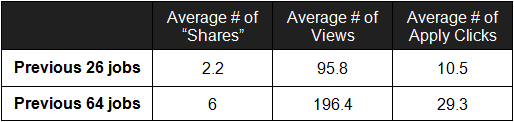
Taking a sample of 26 jobs posted on LinkedIn (from 8/20/12 to 9/20/12), with an average of just 2.2 shares per job, we saw an average of 95 people viewing each job.

However, taking a sample of our 64 jobs (from 6/20/12 to 9/20/12) we had an average of just over six shares per job and an average of 196 views for each job that was posted. Additionally, the first set of data average just over 10 apply-clicks per job, whereas the second averaged 29.

LinkedIn Share data

The data show the number of apply clicks and views is directly correlated to the number of shares.

Types of jobs that don’t draw well with social media advertising

Obviously there are factors outside of how many times a job is shared. The job itself is paramount: A bad job won’t get candidates even if everyone knows about it (everyone will just know it’s a bad job). Another factor is what type of job you’re posting on social sites. Typically, blue collar jobs or hands-on jobs will not draw as well on the internet. The same goes for face-to-face jobs like waiting tables and bartending. The reason for this simply stems from the type of person who is being searched for – an employer must know who the ideal candidate is in order to know how to reach that person.

Types of jobs that do draw well on LinkedIn

We’ve found that management-level positions advertised on LinkedIn tend to do draw well. The reason could simply be that management-level employees understand the importance of having professional networks, and thus use the website regularly. In addition to administrative positions, which are wildly popular everywhere, the most commonly applied for position level was management.

Sales positions have also performed well on LinkedIn as it is a rapidly changing/moving industry, and those candidates are prone to using professional networks to connect with prospects, leads and other companies. Sales reps are always on the move and are always needed somewhere. As such, it comes with the territory to stay up on technology and be active in finding new ways to survey the sales landscape. Additionally, sales representatives know that LinkedIn is an effective sales tool. It is useful to find information about a lead before making a call. As such, sales reps are already using the site, so it makes sense that they’re reachable on the site.

Promoting on other social media sites

As far as the other social sites, they are far behind LinkedIn from an employment standpoint. Facebook boasts targeted pay-per-click advertisements and various company-apps for job-searches, but there isn’t a go-to platform to utilize the network. In the same vein, Twitter is good for sharing jobs and telling people that they’re available, but it does not yet offer a way of knowing how effective it can be as a job-promotion tool.

Takeaway

As you can see, how effectively sharing your jobs on Linkedin has a significant effect on the amount of candidates who will apply for the job. Make sure to encourage your employees to share your company’s jobs as it will extend the reach of each advertisement.

Have you used social media to promote your job ads? How has it worked for you?

Image Credit: http://www.flickr.com/photos/coletivomambembe/

When talking with companies who have identified talent, we often hear the following question: “Should I do a phone interview or should I bring them in to the office, face-to-face?”

The answer is you should always phone interview them before bringing them in for a face-to-face interview.

After looking at resumes and determining who is worth learning more about, a phone interview (or “phone screen”) is the next most important step of the hiring process. Conducting a phone screen can save you a lot of time in the hiring process and help you identify who is or isn’t worth interviewing in person.

What does a phone screen entail?

Phone interviews typically last 15-20 minutes and you can usually identify a strong candidate very quickly. It’s a chance to learn how the applicant thinks and speaks on his/her feet so having a prepared set of questions is key. Questions should explore their work experience, skills and goals so you can get a better handle on who the candidate is. Oftentimes employers will find that a person they were unsure of before conducting the phone screen turns out to be a strong candidate, whereas other times someone they thought was a promising candidate turns out poorly.

Based on your phone interview, you can make much better assessments of your candidates, weed out unqualified candidates, and decide who should come in for a face-to-face meeting.

How many people should I phone interview?

At NewHire, we suggest choosing between five and eight candidates for phone screening as it usually yields three to five candidates who are fit for an in-person interview. Rather than choosing eight people whose resumes looked qualified and bringing them in for full interviews, a phone screen can elicit more information and a general enthusiasm that might be coming from the candidate. Once you’ve decided who is and isn’t worth continuing contact with, you can hone in on the interviews that you do want.

Phone interviews vs. face-to-face interviews

The face-to-face interview, of course, is when you’ll get a true sense of who would make the best fit for your company. You can tell a lot about someone by how they sound over the phone, but getting them in person fills in all of the blanks. For instance, a candidate could be great over the phone but show up for an interview with an un-tucked shirt and looking a mess. Conversely, a candidate can separate themselves from the pack based on how they perform in an interview – even if they weren’t the leading candidate after the phone screens.

While committing to doing phone interviews will take some time up front, it’ll save you time and money in the long run. It is significantly better to spend a few extra hours up-front on getting the right people in the door the first time for interview by phone screening, than it is to waste your time with the wrong candidates in face-to-face interview and having to interview even more people in result.

To help you with your next phone screen/interview, check out our phone screening template.

What questions do you like to ask in phone interviews?

Hiring is not easy for businesses no matter the size – big or small. They share the same pain of hiring, but the effect of a new employee at a small business is completely different than that of a large firm.

Small business hiring is risky business

For small businesses, the pressure is on. A bad hire represents a sunk cost of thousands of dollars and a whole lot of time wasted. This is a drastic move; a smaller budget means that each new hire is a major undertaking. The smaller the company, the more significant that portion of the budget that will be tied up in that person. In the event that the new employee is not a good fit, a significant financial hit will be taken by the company.

On the other side of the coin, if a company like Microsoft is hiring for an entry level sales rep, they can handle losing a few thousand dollars on getting the wrong person. Surely they would prefer to have the right person at every position, but it won’t financially cripple a major corporation to make a couple of mistakes in the hiring department.

Small businesses don’t hire as much

CareerBuilder recently published their job forecast for the 2nd quarter of 2012. Among the many questions that business owners were asked, one stands out: “In the second quarter, does your company plan to increase, decrease, or make no change to its number of full-time, permanent employees?” The answers shed a lot of light on the hiring habits of companies, based on their size.

• 20% of small businesses (50 or less employees) said yes, they are planning to hire someone in the 2nd quarter of 2012
• 22% with less than 250 employees said yes
• 25% with less than 500 employees said yes
• 38% with over 500 employees said yes

So what does this tell us? Small businesses don’t hire as much as larger businesses. As a result, they don’t have much practice or experience which makes hiring a new employee even more difficult.

They also don’t have as many resources. Many times, small businesses don’t even have an HR person, let alone an HR department. In those cases, we find that the hiring is done by either the owner or another employee whose job is typically not HR-based. This takes more time and effort from the entire staff to get the employee trained and on-board, which takes away from productivity and ultimately costs more money.

Small businesses have much more to lose

This isn’t to say that a bad hire doesn’t affect a large company. However, if a company with 10 employees hires someone who ends up being bad for the organization, that’s 10% of their staff. The investment for a small company represents a much larger portion of the company than it does in a large corporation. As such, small-to-midsized businesses need to find the best candidate on their first attempt because they have much more to lose.

As cliché as it may sound, one employee to a company of 750 is like a drop in a bucket. Even if that drop is not as pure as the rest of the water, it’s going to spread so thin that no one will even notice. If that one employee is not working out, they’ll disappear one way or another and the company will continue on.

So how do you make it easier?

Preparation is key! Plan out a hiring process that covers everything from crafting an effective job description, to knowing who’s in charge of managing the hiring process and building an employee on-boarding program. Here’s a few documents we give our clients to help them do this:

  • Employee Value Proposition This document will help you craft your “sales pitch” to prospective employees. It’ll help uncover the key selling points of  the job and what makes your company a great place to work.
  • Crafting an Effective Job Description Bad job descriptions result in poor candidates. Using your EVP as your guide, this document will help you write a great job ad which in turn will help you build larger and better quality candidate pools.

We’d love your feedback; what kind of hiring challenges does your small business face?

There are a lot of factors when deciding whether to pay your employees on a salary scale versus a commission scale. Many of these factors depend highly on the company in question.

Here are two questions you need to ask yourself first:

1. What type of salesperson are you looking for?

In many cases, commission-based sales draw a certain type of salesperson. The stereotypical “hunter” mentality comes with commission sales; someone who is there to sweet-talk, make a sale, and move on. These people are good at what they do, but they are difficult to hold on to and are often less apt to buy into a team/corporate mentality. Moreover, there is very high turnover in this type of role because not everyone who thinks they’re going to succeed will actually do so.

2. Can you comfortably make the distinction on how much you’re willing to give as a commission?

There is a balance to strike within rate-of-commission: Some jobs are 100% commission (real estate, insurance) while others are base-plus-commission (most product-based sales). Each has its advantages and disadvantages and those should be addressed before hiring anyone. Commission-only will increase the chance of a revolving-door of employees while base-plus-commission will provide a little more job security for a new employee.

There is a fear of salespeople taking their clientele and leaving when they’re on commission, because once they have those clients, they’re “safe.”  This model breeds an attitude of looking out for oneself which can create a sort of divide within the company. If salespeople aren’t treated like other employees, there can be a rift in cohesion of a staff. Norm Brodsky believes that this problem is real and affected his company regularly. Thus he started offering base + commission for the first two years, then, upon offering full-time/long-term employment, eradicating the commission altogether and offering a higher, safer salary.

With a set salary in place – particularly one that is near what a salesman would have been getting on commission in a comparable role – you’ve essentially offered that employee peace of mind. Commission breeds an air of “if I don’t sell, I don’t get paid” and that creates a more stressful work environment.

If you’re looking for a set-up that encourages sales and may have slightly less focus on account maintenance and service, then commission is probably the way to go. Commission-based pay puts all the emphasis on the successful completion of a sale; whether or not it is best for a long-term outlook for the company depends on the company. If you’re making more money due to high-sales, you have more money to reward the people who are bringing in these high-volume sales.

Whichever pay structure you choose, the most important aspect is to make sure it has been clearly communicated to the employees.