Archives For Step 2 – Build a Candidate Pool

Indeed is the current juggernaut in the online recruitment advertising, delivering 38% of all applicants to a sampling of 66 open positions. This is more than any other single job board. The runner up, CareerBuilder, does not even come close. But that’s not the whole story because the combination of Careerbuilder, LinkedIn, Craigslist and all other boards delivered 62% of the total number of job applicants.

When sourcing candidates you can’t know in advance which source is going to provide the person you will hire. So our data shows that it is important to advertise your open position to as many jobseekers as possible.

In a previous blog, “Top Job Boards in 2013”, we explored which job boards delivered the most job-seekers. Our next step was to find out which of those job-seekers turn into applicants. What we found surprised us, and we think it might surprise you too.

The application rate — the conversion from job-seeker to applicant — from Indeed is far and away the lowest of any site surveyed. A strikingly high percentage of the job-seekers coming from CareerBuilder and LinkedIn are completing the applications.
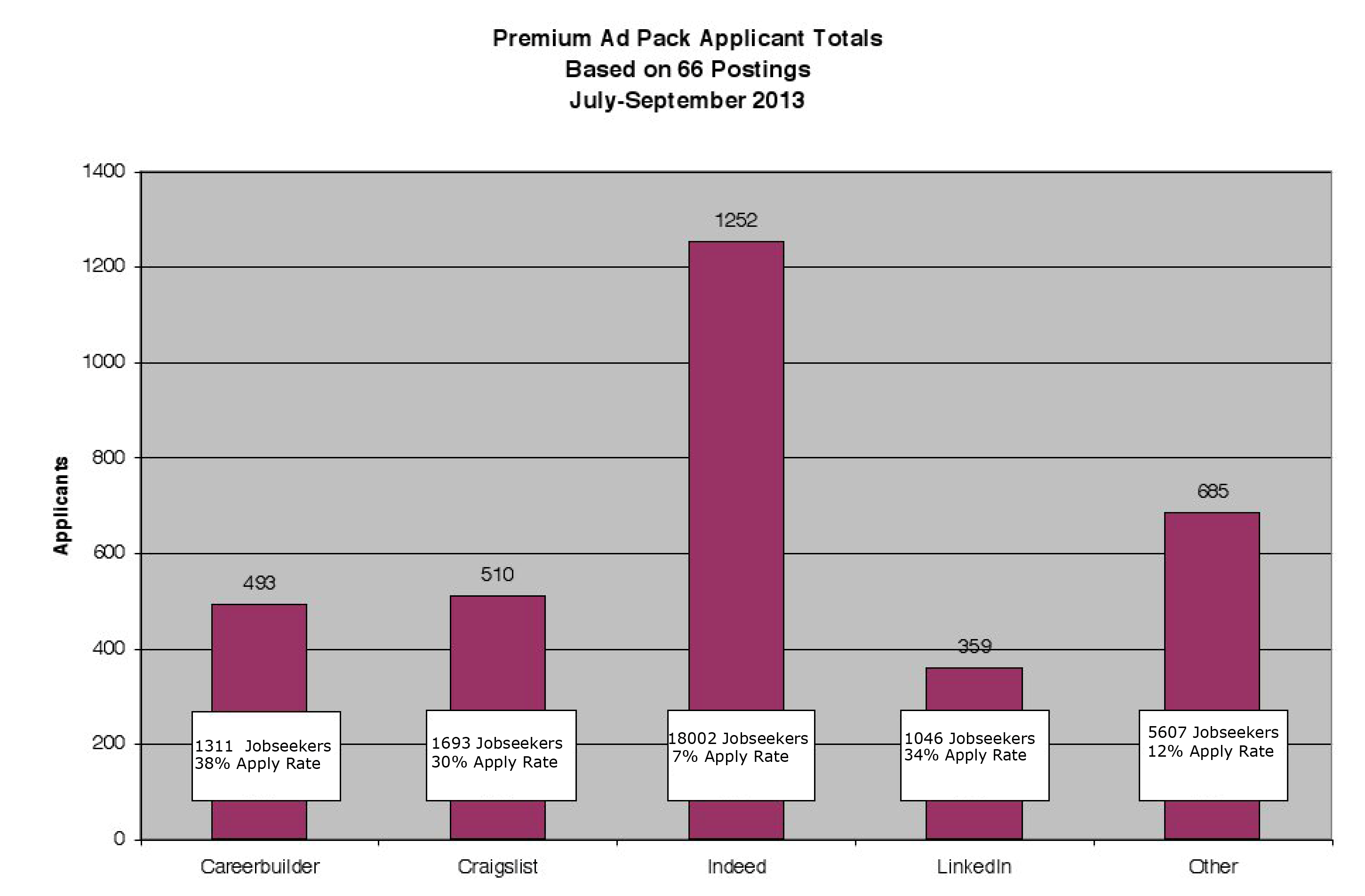
Google Analytics Premium Ad Pack Applicant Totals Jul-Sept 2013 - small

Indeed accounts for almost 3 times the number of applicants than any other job board. We expected Indeed to be the leader because Indeed provides 10 times the number of job-seekers as the runner-up. But, the application rate from Indeed is the lowest of any site surveyed.

Here’s the first surprise: A high percentage of the job-seekers coming from CareerBuilder and LinkedIn are completing the applications. The application rate (conversion of job-seekers to candidates) is 38% for CareerBuilder, 34% for LinkedIn and 30% for Craigslist, while Indeed’s application rate is a lowly 7%.   

Here is what we think is happening. Applicants who use Indeed only see a small snippet of the ad. To see the entire ad, they have to click through and view NewHire’s application page, boosting Indeed’s job-seeker statistics. In comparison, applicants using CareerBuilder or LinkedIn can see the entire text of the ad and don’t need to click though. If they do click through, they are more likely to apply for the job.


The world of “other” job-boards continues to surprise.

The right bar in the graph labeled, “other,” is a combination of every other job site that referred job-seekers and applicants to NewHire. This group of “other” job sites sends us our second highest number of applicants and job-seekers. It’s crazy that the #2 performer is coming from sites that we don’t intentionally post to.

With thousands of smaller job-sites around the web continually picking up each other’s jobs, the Internet is working its interlinked magic to bring you more candidates.

So what does it all mean to you?

As job boards and aggregators feed into each other, the number of people who have access to your job ad increases. The job ads will even feed into sites that you never expected, driving more traffic. Continue posting job ads on a wide range of websites to maximize your exposure and build your pool of candidates!

How did we get all this data?

This graph shows the total number of applicants who applied to NewHire jobs between July and September 2013. Each of the 66 jobs shown here were advertised on the job boards shown, during concurrent time periods. All job-seeker and applicant data is gathered from Google analytics. A job-seeker viewed the NewHire application page while an applicant submitted the NewHire application with the minimum required fields.


Running businessman.

The number one priority of a hiring process is to get the right person for the job.   However, a focus on the “perfect” candidate, a poorly constructed hiring process or just general anxiety about the investment you are making can lead many hiring managers to indecision, losing time, money and candidates along the way.  We strongly recommend having a well defined idea of what you are looking for, a realistic expectation of the applicant market, and a commitment to keep things moving.  Here are some outcomes of waiting too long to reply to candidates:

1) Candidates get other jobs

Simply put, the best candidates receive other offers and the longer you delay in making an offer, the more likely that they will accept another position.  This happens frequently and it is part of the process, but try to minimize this by eliminating any delays.

2) You lose time

In the event that a quality candidate is no longer in the running for the position, you have not only lost their talents, but will also have nothing to show for the time that you and your staff may have invested in recruiting them.  Maybe you will have gained something – the hard earned knowledge that tarrying can lead to losing top talent.  Don’t learn the hard way; have a planned and formal hiring process that will efficiently move candidates through interviews and allow you to decisively evaluate their qualifications.

3) It hurts your reputation

As was discussed in a previous blog post, prompt communications with applicants will project a positive company image of decisiveness and courtesy.  By promptly responding to applicants and maintaining momentum in the hiring process, you will demonstrate not only respect for the time that people have already invested but also an acknowledgement that prospects have other options.  Job seekers communicate their experiences with other people – who knows, they might even be future clients.

4) It might set the wrong tone about expectations and management style

As a manager, make a strong first impression by showing your future employee what you expect.  The way that you behave during the hiring process will send strong messages to prospects about how you make decisions and how your company operates.

5) It costs you money

If you have lost a good candidate because they have accepted another offer or lost interest, you will have to recruit new prospects.  This will require the purchase of more advertising and the investment of more time.  You will also have to continue with your interim arrangements for managing the vacant position’s responsibilities.

You want to get a qualified person in there and you don’t need to rush the decision, but the implementation of a hiring process will help shepherd you through and be timely about things.   Prompt and courteous responses are also due to unqualified candidates who you have interviewed. If they follow up, let them know where they stand.

resumesIt’s kind of amazing the amount of flak that job boards like Craigslist and CareerBuilder are getting from hiring managers.  It seems that there’s a growing consensus that job boards are ineffective tools for sourcing candidates.  Call me a detractor, but there’s nothing wrong with job boards.  It’s the lack of a process for utilizing them that’s the real problem.  Simply put, if you’re not using an applicant tracking system in tandem with a job board, you might as well throw your stack of resumes in the air and hope the right one lands in your lap.

Take a look at your sink. Imagine that instead of that nifty faucet with its spout funneling the water into your cup and its nozzles controlling the flow and temperature, there was just a hole at the top.  Without the faucet, you have no control over how much water you’re getting, where it’s going, or even how hot you want it.  The only way that your sink serves as a useful tool in your kitchen is if it’s paired with a faucet.  Otherwise all you have is a really effective way to soak your kitchen and/or possibly drown.

So therein lies the problem with job boards.  It’s not that they don’t deliver; it’s that they deliver too much – like a sink with no faucet.  Hiring managers are losing faith in job boards because they are getting overwhelmed by dozens, sometimes hundreds, of applications.  The problem with getting that many applications is that it’s simply too many to manually sort through.  There are undoubtedly qualified candidates in that pool, but finding them is like finding that needle in a haystack.

You’re not a robot and you don’t have an infinite amount of time, so at best, reviewing every application for the right mix of skills and experience is going to be a massive, time-consuming effort.  But dumping that entire pool of applicants into the trash bin isn’t a smart move because there are qualified candidates who match up well with the job.  You need a solution that that combines the speed and accuracy of a robot with the skills of a hiring manager.  You need a solution that efficiently sorts through the applicant pool so that you can find those qualified candidates.

NewHire is an applicant tracking system that hundreds of companies have used to hire thousands of employees, with the vast majority of those hires coming from the biggest job boards.  This isn’t so much a pitch for NewHire as it is a testament that job boards are not the useless avenue of recruiting that some hiring managers would have you believe.  For your money, there is no better way to reach as large an audience or to get as deep an applicant pool as through a job board.  However, if you want to maximize the benefit you get from using a job boards, you need a system in place that cuts through the unqualified applicants and just delivers the candidates you want to see.

http://www.flickr.com/photos/76029035@N02/

Recruitment advertising is one of the most complicated parts of the hiring process – it’s hard to manage, can be costly, and if you’re doing it on your own, it’s hard to know its true ROI.

Here are three mistakes businesses make in their recruitment advertising, and some quick tips you can use to fix them right now.

1. Publishing your job ad on the wrong day.
Here’s a little insider tip – we looked at some of our data at NewHire to see when candidates are applying for jobs and found that Mondays and Tuesdays are the most popular days.

Day Jobseekers
Mon

33,115

18%

Tues

33,935

18%

Wed

31,129

17%

Thurs

29,336

16%

Fri

24,772

13%

Sat

15,800

9%

Sun

17,642

9%

Grand Total

185,729

100%


*Data is based on the number of visitors to the NewHire Job Board from Sept 2011 – Feb 2012.

We recommend to our clients that they publish their job ads on Fridays or early Monday mornings to help get the best results possible.

2. Having a boring intro.
It’s a job advertisement! Sell your company and the job – your job ad needs to be engaging all the way through and attractive to your target candidate. Your intro paragraph is where it all starts.

People have short attention spans. It only takes applicants 15 seconds to look at your job advertisement to know if the position is something they’re interested in, and the company is somewhere they want to work. The first paragraph of your job advertisement must be attractive and interesting enough for candidates to keep reading and get excited about the position. Make that 15 seconds count and you could see more applicants.

3. Not selling the job
If you want to attract top talent – you need to bring your A-Game. Employees not only want to earn more, but they want to learn more and do more.

In your job ad, be sure to highlight the most attractive aspects of the position and the company. Here are a few example questions to answer in the ad:

  • What makes your company a great place to work?
  • What is the work culture like?
  • What perks do you offer employees?
  • Is there room for growth in the position?
  • What does your benefits package include?
  • Do you offer training and development plans?
  • Where is the office located? (for example, if you have a downtown office over looking Lake Michigan – brag about it!)
  • Do you offer flexible hours? Is there opportunity to work from home?

Again, keep in mind what your ideal candidate would value in the job. What makes you a great employer and your company a great place to work?

Takeaway
While there is no magical “fix-all” to get the ultimate results, there are certainly some small things you can do. Use these tips and you could see improvements to your applicant results.

Is it worth the money to sponsor jobs on Indeed (pay-per-click advertising), when there is a free (organic) option available? At NewHire we hear this question pretty frequently.

The short answer is “yes,” purchasing sponsored (pay-per-click) advertising on Indeed is worth the investment. But I don’t expect you to take me at my word; instead, I’d like to show you the evidence that it’s worth to sponsor jobs on Indeed.

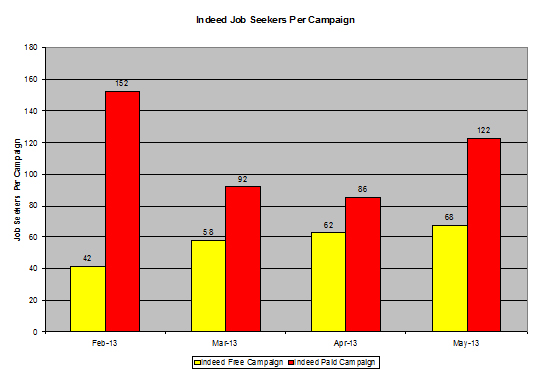
Indeed sponsored ads campaigns attract an average of 113 job seeker views per campaign while organic (free) campaigns attract 57 job seeker views per campaign. This means that a sponsored campaign on Indeed attracts almost twice as many job seekers as organic campaigns.  Here is a graph showing the information for 4 recent months.

Indeed jobs chart

How did we get this information?

(As a recovering nerd I just can’t help but provide the details.)

We track recruitment advertising Return-On-Investment (ROI), so that we can provide our customers with information about how best to spend precious advertising dollars to build a candidate pool. We use Google Analytics, Server logs, and applicant data in NewHire to collect and compile the information we provide.

Here’s the data averaged for February, March, April and May 2013:

Total Active Campaigns

Average

Active Jobs

407

Total Job Seeker Views (traffic)

28454

Total Applicants (all sources)

5563


Indeed Campaigns

Free Campaign Average Paid CampaignAverage
Number of Campaigns

158

45

Total Job Seekers Views (traffic)

9157

4773

Job Seekers per Campaign

57

113


Averages shown are for managed campaigns Feb, March, April and May 2013. Only job seekers from Indeed were considered for this table.

Looking at the Job Seeker traffic, you’ll notice that all the job seekers coming from Indeed only represent a small fraction of our total Job Seeker traffic.

Where does that other candidate traffic come from? For the active jobs discussed here, Indeed is just ONE of many advertising outlets being used to promote each job. Candidates are coming from CareerBuilder, Craigslist, LinkedIn, and the NewHire job board, (and these are just primary sources). For information comparing various job boards’ ROI, visit our previous blog “Top Job Boards of 2013. (/blog/top-job-boards-2013-job-sites-post-job-ad/)

Remember that Job Seeker traffic is also coming from emails and from a myriad of other partner job boards that are re-posting ads. Stay tuned for more updates — over the coming months we’ll continue to explore candidate traffic sources!

http://www.flickr.com/photos/76029035@N02/

Building a solid candidate pool for an open position can be a challenge. Employers need to be aware that they could be their own worst enemy. Employers can create a negative impression when candidates have a poor or unpleasant experience applying for the position. However, when employers consider the candidate perspective it is easy to find a few ways to improve the process. These six actions will improve the candidate experience and also improve and build your candidate pool.

1. No Broken Links

Make sure the “apply” link from the job board to your application is working. Nothing is more frustrating for a candidate than finding a job listing for the perfect job and not being able to apply because the “apply” link is broken.

2. An Easy to Use Application

In recent data released by CareerBuilder, 52% of candidate’s don’t apply because of some issue with the technology of the application! Wow. Don’t lose half your candidate pool because of technical issues.

3. Your Employment Brand Matters

Provide clear information about the job and the company. 87% of candidates applied for jobs where they reported the posting was very effective. However, if they felt that there wasn’t enough information about the job or the company they were much less likely to apply.  According to US News, “…employers should provide a clear and honest description of the role.”

4. Improve Candidate Confidence

Candidates are savvy and smart. If your company is not a well known brand, it’s important to include additional information that builds confidence in the job and the company. Include your web address, the salary range you’re offering, and information about key products, industries or customers.

5. Candidates Hate Being in a Black Hole

If you’ve spoken to a candidate on the phone or in a face-to-face interview, let them know what’s going on.

6. Respect Your Candidates’ Time

If you are using screening questions, ask questions that are related to the job. If the job the candidate is interviewing for has changed a lot from what was advertised, let candidates know. Don’t let the final stages of the process drag on into a seemingly unending set of interviews and assessments.


job gauntlet

The best performing job ads sell both the company and the open position to potential candidates, attracting a strong response and a solid pool of qualified candidates. Our experience and data consistently show that the best performing job postings – those which provide the greatest number of qualified candidates – have a clear value proposition for applicants. The employment value proposition is a statement that answers these two questions:

  • Why is this company a good place to work?
  • What are the interesting and attractive duties and responsibilities of the open position?

When you include this kind of information about the open position and company, your ad will stand out to job seekers. But one look at the majority of ads on any of the major job boards tells a different story.

Here are two examples of poor advertising strategies that are running on major job boards at this time:

  • In one ad, the company description consists solely of “a fast-growing, dynamic company seeks a…” and then lists all required qualifications. If all a candidate knows about a company is that it’s fast-growing and dynamic, then they become meaningless adjectives and it can be a turn-off to people looking for a rewarding position at a good company.
  • Another ad listed 17 “must-have” qualifications immediately followed by this phrase: “A criminal background check (both state and federal) WILL BE PERFORMED before a hiring decision is made!” Emphasis on that many qualifications immediately followed by the threat of a background check conveys distrust in employees and a hostile office environment.

These types of ads conjure images of employers scrambling to develop foolproof gauntlets of “musts and must nots” to deter people from applying. While this may sound familiar, it’s not a best practice for attracting top talent.

If you’re currently using the gauntlet method to prevent unqualified applicants from applying to your job, stop! When you screen and identify qualified candidates using application questions, there is no need to use the classified ad to deter people from applying. In fact, the opposite applies. Use the classified ad as a sales and marketing tool and feature the best aspects of open position. In short, sell your company and your job.

If you’re writing the ad yourself and you’re unsure of where to start, we’ll make it easy for you. We have designed this fill-in-the-blank Job Ad Mad Libs® as a guide to the elements which help set your recruitment advertisements apart from those that use the gauntlet method.

http://www.flickr.com/photos/76029035@N02/

Hiring a new employee is one of the most difficult parts of running a business. Even if you have a great hiring process, it takes a bit of work, patience and persistence. Sometimes it’s a struggle to find even one good candidate and other times when you think you found the perfect candidate… they don’t pan out.

At NewHire, we’ve seen an awful lot of strange behaviors and actions from candidates – everything from people arriving for an interview wearing shorts to being hung up on during a phone screen. To help you prepare for your next hire, we’ve put together a little list of what you can expect when you’re expecting …a new employee.

Candidates are flaky.

We’ve seen final candidates drop out of the race without notifying anyone, not show up for interviews, and never return calls or emails. On a typical set of phone screens, we’ve found that around 15% of the people we contact will never respond to our calls or emails. Even if it seems like one candidate is a perfect fit, don’t stop looking! We’ve seen some of the most promising candidates slip through the cracks. If they’re a great candidate, they might be getting other offers. Don’t sit back and assume you’ve got someone in the bag – keep looking and make sure you have a hot standby.

Candidates don’t follow directions.

Every NewHire job application includes a space to attach a resume. It also includes instructions on what to do if you’re having problems attaching your resume. In spite of this, roughly 10-15% of applicants still don’t attach their resume.

It varies from job to job, but as a general rule you can expect at least 10% of respondents to neglect to send you their resume on an online application.

Candidates are often unqualified.

Especially in this job market, candidates are trying to get any job they can and often apply for jobs they are not qualified for. For example, if 100 people apply for your open position, you’ll find that 10-20% are “qualified,” meaning they meet the experience level, degree and skills required for the job. However, a significantly smaller number will actually be “right” for the job. When an employer pares down for what they’re really looking for, the typical rate of people worth interviewing can drop to less than five out of that 100 person candidate pool. Again, this varies quite a bit between jobs, but go into the hiring process with the understanding that a small number of candidates are interview-worthy.

Candidates are unpredictable.

It’s no surprise that candidates get nervous during interviews – it happens to the best of us – but sometimes they do strange things because of it. We’ve had candidates get sick, start talking about family secrets and history, reveal too much information about their personal life, and even toss around four-letter-words as if they were at a bar with their friends. Make sure you’re well prepared for candidate interviews. Always have a strong list of questions prepared in advance that you can lean on in case things get weird.

Expect the unexpected.

You never know what you’ll come across when you start the search for a new employee. But one thing is for sure… expect the unexpected!

Do you have any crazy candidate stories? We’d love to hear about them!

“What’s the best job board to publish my job ad?”

We get this question often at NewHire so we keep track of which job boards are referring the most job seekers and how they stack up against one another.

Over the past 15 months, we’ve published over 1100 online job applications for small and mid-sized companies around the US. We took a sample of those 1100 jobs and examined 169 that were advertised on each of the following job boards simultaneously: CareerBuilder, Craigslist, Indeed, SimplyHired and LinkedIn.

We then looked at how the job boards performed relative to one another. This graph shows how many job seekers viewed each job ad from each of these major job boards.

top job boards 2013

As you can see, Indeed is by far the winner. This data included both organic and sponsored ads on Indeed.We saw Indeed’s popularity take off in 2011 and it’s been growing ever since. Because of Indeed’s growing popularity, we recommend publishing all job ads on Indeed, and offer additional sponsored advertising for added exposure. Indeed is beating all the other job boards for bringing in the most candidates.

In fact, Indeed doubles the number of candidate referrals attracted by LinkedIn, SimplyHired, Craigslist and CareerBuilder COMBINED. Take a look:

Job Seekers

It’s obvious that Indeed is killing it in the job board world. But there’s a few important things you need to know:

  • Don’t put all of your eggs in one basket. Just like you should have a diversified investment portfolio, you should also have a diversified recruitment advertising plan. We saw Monster.com, previously a staple in the job board industry decline in popularity so much that the cost for the job ad was no longer justifiable. (Subsequently, we stopped providing their ads.) If you post your job ad on only one job board, you’re limiting your candidate pool, and missing out on a lot of great potential talent.
  • Quantity doesn’t always mean Quality. Yes, Indeed brings in the most candidates, but they might not all be equally well qualified. Don’t neglect industry job boards or referrals from current employees or other people in your network.
  • The good die young. Even though Indeed is the most popular job board right now, I can almost guarantee it won’t be forever. MySpace was also the most popular social network for a while… and we saw what happened there, and that didn’t take too long. The same goes for Monster.com.

Want to keep up on more of recruiting advertising and hiring tips and trends? Get our newsletter!

arms in airSo you’ve posted a job, advertised it, received a strong number of candidates, reviewed them all, and you’re not satisfied with any of them. What now?

While this is not an ideal situation, there are a few steps to take:

1. What did you learn the first time around?

The only way to solve a problem that you’re having with candidates is by figuring out what the problem is. Are they unqualified? Was your initial idea of what you were looking for off-the-mark? Are they completely over/under-qualified as a group? Are there numerous candidates who are worthy of the job but you just don’t feel like any is the “right” one?

Once you’ve figured out what the actual problem is, the solution will be clearer to you. While it seems natural, throwing your arms up in frustration will actually not garner more applicants for a job.

2. Get a second opinion

There is a chance that you’ve simply been too hard on the candidates in your screening process. The perfect candidate almost never exists, so don’t hold out for something you won’t get. Know that you’re going to mold the candidate into what you need them to be – this certainly doesn’t mean you should settle on someone, but it does mean that you don’t need someone who matches every single criteria you can come up with. If you can’t let yourself relax on the standards, a second (or third) set of eyes may help shed some light on your expectations. Find someone within your company whose opinion you value, then let that person take a look at the candidate pool. There is a solid chance that they’ll see something that you won’t.

3. Reassess the job

Sometimes when a manager is having a difficult time with candidates, there is a disconnect between what they thought they wanted and what they actually need from a candidate. If the candidates are not matching up with your expectations, take another look at people who have recently held the open position and try to figure out what exactly made them successful. Write this information down separate from the job requirements, and then compare the two lists. If they do not match up, then you’ve found your problem.

4. Think about what you’re offering

This is often related to reassessing your job. Perhaps you’ve written a job ad that states you want someone with 10 years of experience and are willing to pay them $65,000/year. However, as you search through your candidates, the ones who would take $65,000 do not have 10 years experience – meanwhile, those who do have the experience are all stating that they’d need $90,000 or more. The only real way around this is to figure out which one you’re willing to sacrifice. If the amount of experience is less important, then you can make your $65k offer, but if you feel that you need the experience, you’ll have to make a financial concession. On the bright side, a great employee is usually worth a lot of money to the company.

5. Advertise more

Spending extra money is rarely what a hiring manager wants to do, but it is the reality of the search. If you need more candidates, you must spend more money on advertising. Whether this means doubling your presence on sites like Craigslist, CareerBuilder, or LinkedIn, or finding a niche site that targets a different market, you’ll need to find ways to reach more (and new) job-seekers. In order to reach a different crowd, look into targeted pay-per-click (PPC) campaigns as a way to reach a group that you think is on-pace with what you want. We’ve found a lot of success with Indeed sponsored ads (PPC campaigns).


There is no “trick” to getting the right people to apply when you’re not satisfied with the current applicants. However, there are a lot of methods that could help boost the candidate pool when you’re sensing that something is missing.