Archives For Recruitment Advertising

http://www.flickr.com/photos/76029035@N02/

Recruitment advertising is one of the most complicated parts of the hiring process – it’s hard to manage, can be costly, and if you’re doing it on your own, it’s hard to know its true ROI.

Here are three mistakes businesses make in their recruitment advertising, and some quick tips you can use to fix them right now.

1. Publishing your job ad on the wrong day.
Here’s a little insider tip – we looked at some of our data at NewHire to see when candidates are applying for jobs and found that Mondays and Tuesdays are the most popular days.

Day Jobseekers
Mon

33,115

18%

Tues

33,935

18%

Wed

31,129

17%

Thurs

29,336

16%

Fri

24,772

13%

Sat

15,800

9%

Sun

17,642

9%

Grand Total

185,729

100%


*Data is based on the number of visitors to the NewHire Job Board from Sept 2011 – Feb 2012.

We recommend to our clients that they publish their job ads on Fridays or early Monday mornings to help get the best results possible.

2. Having a boring intro.
It’s a job advertisement! Sell your company and the job – your job ad needs to be engaging all the way through and attractive to your target candidate. Your intro paragraph is where it all starts.

People have short attention spans. It only takes applicants 15 seconds to look at your job advertisement to know if the position is something they’re interested in, and the company is somewhere they want to work. The first paragraph of your job advertisement must be attractive and interesting enough for candidates to keep reading and get excited about the position. Make that 15 seconds count and you could see more applicants.

3. Not selling the job
If you want to attract top talent – you need to bring your A-Game. Employees not only want to earn more, but they want to learn more and do more.

In your job ad, be sure to highlight the most attractive aspects of the position and the company. Here are a few example questions to answer in the ad:

  • What makes your company a great place to work?
  • What is the work culture like?
  • What perks do you offer employees?
  • Is there room for growth in the position?
  • What does your benefits package include?
  • Do you offer training and development plans?
  • Where is the office located? (for example, if you have a downtown office over looking Lake Michigan – brag about it!)
  • Do you offer flexible hours? Is there opportunity to work from home?

Again, keep in mind what your ideal candidate would value in the job. What makes you a great employer and your company a great place to work?

Takeaway
While there is no magical “fix-all” to get the ultimate results, there are certainly some small things you can do. Use these tips and you could see improvements to your applicant results.

Is it worth the money to sponsor jobs on Indeed (pay-per-click advertising), when there is a free (organic) option available? At NewHire we hear this question pretty frequently.

The short answer is “yes,” purchasing sponsored (pay-per-click) advertising on Indeed is worth the investment. But I don’t expect you to take me at my word; instead, I’d like to show you the evidence that it’s worth to sponsor jobs on Indeed.

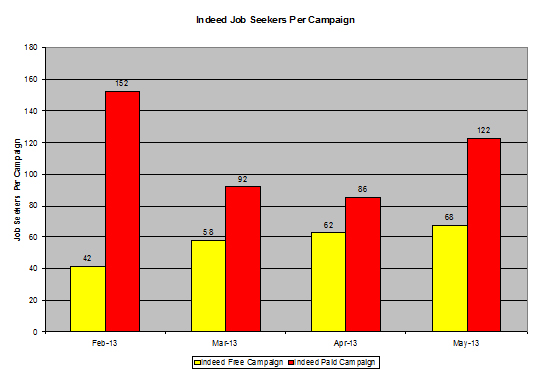
Indeed sponsored ads campaigns attract an average of 113 job seeker views per campaign while organic (free) campaigns attract 57 job seeker views per campaign. This means that a sponsored campaign on Indeed attracts almost twice as many job seekers as organic campaigns.  Here is a graph showing the information for 4 recent months.

Indeed jobs chart

How did we get this information?

(As a recovering nerd I just can’t help but provide the details.)

We track recruitment advertising Return-On-Investment (ROI), so that we can provide our customers with information about how best to spend precious advertising dollars to build a candidate pool. We use Google Analytics, Server logs, and applicant data in NewHire to collect and compile the information we provide.

Here’s the data averaged for February, March, April and May 2013:

Total Active Campaigns

Average

Active Jobs

407

Total Job Seeker Views (traffic)

28454

Total Applicants (all sources)

5563


Indeed Campaigns

Free Campaign Average Paid CampaignAverage
Number of Campaigns

158

45

Total Job Seekers Views (traffic)

9157

4773

Job Seekers per Campaign

57

113


Averages shown are for managed campaigns Feb, March, April and May 2013. Only job seekers from Indeed were considered for this table.

Looking at the Job Seeker traffic, you’ll notice that all the job seekers coming from Indeed only represent a small fraction of our total Job Seeker traffic.

Where does that other candidate traffic come from? For the active jobs discussed here, Indeed is just ONE of many advertising outlets being used to promote each job. Candidates are coming from CareerBuilder, Craigslist, LinkedIn, and the NewHire job board, (and these are just primary sources). For information comparing various job boards’ ROI, visit our previous blog “Top Job Boards of 2013. (/blog/top-job-boards-2013-job-sites-post-job-ad/)

Remember that Job Seeker traffic is also coming from emails and from a myriad of other partner job boards that are re-posting ads. Stay tuned for more updates — over the coming months we’ll continue to explore candidate traffic sources!

http://www.flickr.com/photos/76029035@N02/

You might have heard one of our sales professionals or staffing coordinators answer: It depends on the relative attractiveness of the job and the relative scarcity of candidates. While it might sound like something from a freshman economics class, it’s the truth.

When employers request our NewHire Professional full-service recruiting solution, we gather information on the time-to-hire by industry and by job type. Of more than 100 positions filled using NewHire Professional,

  • 15 were Accounting positions (or related financial fields),
  • 28 were Management positions,
  • 22 were Administrative positions,
  • 25 were Sales positions,
  • 15 were IT positions,
  • 5 were Engineering positions, and
  • 2 were Draftsmen positions.

On average, we filled these positions in 65 calendar days.

What can you do to make any hire a smooth and efficient hire?

Manage Your Own Expectations

When we help hire for an industry with near full employment, such as insurance or civil engineering, expect the average fill time to double, regardless of the type of position being filled. But when we recruit for administrative personnel, expect to fill the job much more rapidly in 35 or so days.

Moral of the story? Your industry will ultimately determine how quickly you can hire. If you are in the unfortunate position of needing to hire scarce candidates, do everything you can to make your opportunity more attractive.

Make Your Opportunity More Attractive

Naturally, an employer could attract more candidates by offering a higher salary than the competition, offering tuition reimbursement, providing an extra week of vacation each year, or offering more perks than a candidate can count on two hands. All of these are excellent strategies, but if you’re like many employers, you don’t have extra money/perks to throw at candidates. In that case, be creative (yet honest) when making your job more attractive than the next.

Employ any of these strategies and you’ll soon be employing your potential hires as quickly as possible:

  • Express to your candidates how great it is to live/work in your city/state.
  • Explicitly describe what sets you apart from other companies in the industry. Is it your product line? Your office environment? Your commitment to the community?
  • Give an insight into what separates your corporate culture from other companies.
  • Advertise in creative ways and in creative places.

Secret hiring

It is often not the first choice or the best choice, but there are times when an employer must conduct a confidential search to find and hire a new employee. Perhaps you’ve come to depend on a “good employee gone bad” and can’t fire until you hire, or perhaps you don’t want the competition to know you are in the market for talent. Whatever the reason, here are a few tips on how to keep your confidential search confidential:

Keep the circle small.

The fewer people who know about the confidential search within your own company, the more likely the search will remain confidential.

Write the ad to be attractive to your target candidate.

Write your recruitment advertisement as if the search is not a secret, but then carefully edit the ad looking for information that may give away your identity. Why go to the trouble? Even though you are not giving away the name of your company, exact location and industry, you still need to include the information that will attract talent.

Take out identifying information.

Remove the obvious items like company name, website and geography (especially if you are in a smaller town). Then think about the less obvious stuff. Is your company identifiable by its industry? If you are the only fish hatchery in your area, then identifying your industry will give away your identity. On the other hand, most places have many seafood restaurants. You may also have to exclude special designations (like an MBE / WBE / DBE) that can identify you.

Place your advertising confidentially.

Make sure that your company name is NOT included in job ads. Many sites, like Indeed and Craigslist, require registration so that they have your contact information and have additional fields or processes to make the posting blind or confidential. Recruiting and applicant tracking software often has ways to post jobs confidentially.

Give candidates a way to respond privately.

Once your advertising is live, job seekers will respond. Calling the main phone number of your company is not a good option for keeping things confidential. Even using your own email address can be a giveaway. Some people create a separate email account from a public provider like Gmail or Yahoo to receive resumes. If your company uses Recruiting Software or an applicant tracking system, it should have a way to manage confidential responses.

Reinforce confidentiality with your candidates.

Once you begin speaking to candidates remember to explain to them why the search is confidential and ask them to respect the process.

Be prepared for failure.

Sometimes all of the preparation and precautions fail and the word gets out that you are hiring. Be prepared to deal with the consequences. Which brings up another question:  Why does the recruiting have to be confidential? See related post.

When it comes to confidential recruiting and hiring, don’t do it unless you have to. And if you do, be careful!

Have you had to hire in secret before? How did it go?

“What’s the best job board to publish my job ad?”

We get this question often at NewHire so we keep track of which job boards are referring the most job seekers and how they stack up against one another.

Over the past 15 months, we’ve published over 1100 online job applications for small and mid-sized companies around the US. We took a sample of those 1100 jobs and examined 169 that were advertised on each of the following job boards simultaneously: CareerBuilder, Craigslist, Indeed, SimplyHired and LinkedIn.

We then looked at how the job boards performed relative to one another. This graph shows how many job seekers viewed each job ad from each of these major job boards.

top job boards 2013

As you can see, Indeed is by far the winner. This data included both organic and sponsored ads on Indeed.We saw Indeed’s popularity take off in 2011 and it’s been growing ever since. Because of Indeed’s growing popularity, we recommend publishing all job ads on Indeed, and offer additional sponsored advertising for added exposure. Indeed is beating all the other job boards for bringing in the most candidates.

In fact, Indeed doubles the number of candidate referrals attracted by LinkedIn, SimplyHired, Craigslist and CareerBuilder COMBINED. Take a look:

Job Seekers

It’s obvious that Indeed is killing it in the job board world. But there’s a few important things you need to know:

  • Don’t put all of your eggs in one basket. Just like you should have a diversified investment portfolio, you should also have a diversified recruitment advertising plan. We saw Monster.com, previously a staple in the job board industry decline in popularity so much that the cost for the job ad was no longer justifiable. (Subsequently, we stopped providing their ads.) If you post your job ad on only one job board, you’re limiting your candidate pool, and missing out on a lot of great potential talent.
  • Quantity doesn’t always mean Quality. Yes, Indeed brings in the most candidates, but they might not all be equally well qualified. Don’t neglect industry job boards or referrals from current employees or other people in your network.
  • The good die young. Even though Indeed is the most popular job board right now, I can almost guarantee it won’t be forever. MySpace was also the most popular social network for a while… and we saw what happened there, and that didn’t take too long. The same goes for Monster.com.

Want to keep up on more of recruiting advertising and hiring tips and trends? Get our newsletter!

arms in airSo you’ve posted a job, advertised it, received a strong number of candidates, reviewed them all, and you’re not satisfied with any of them. What now?

While this is not an ideal situation, there are a few steps to take:

1. What did you learn the first time around?

The only way to solve a problem that you’re having with candidates is by figuring out what the problem is. Are they unqualified? Was your initial idea of what you were looking for off-the-mark? Are they completely over/under-qualified as a group? Are there numerous candidates who are worthy of the job but you just don’t feel like any is the “right” one?

Once you’ve figured out what the actual problem is, the solution will be clearer to you. While it seems natural, throwing your arms up in frustration will actually not garner more applicants for a job.

2. Get a second opinion

There is a chance that you’ve simply been too hard on the candidates in your screening process. The perfect candidate almost never exists, so don’t hold out for something you won’t get. Know that you’re going to mold the candidate into what you need them to be – this certainly doesn’t mean you should settle on someone, but it does mean that you don’t need someone who matches every single criteria you can come up with. If you can’t let yourself relax on the standards, a second (or third) set of eyes may help shed some light on your expectations. Find someone within your company whose opinion you value, then let that person take a look at the candidate pool. There is a solid chance that they’ll see something that you won’t.

3. Reassess the job

Sometimes when a manager is having a difficult time with candidates, there is a disconnect between what they thought they wanted and what they actually need from a candidate. If the candidates are not matching up with your expectations, take another look at people who have recently held the open position and try to figure out what exactly made them successful. Write this information down separate from the job requirements, and then compare the two lists. If they do not match up, then you’ve found your problem.

4. Think about what you’re offering

This is often related to reassessing your job. Perhaps you’ve written a job ad that states you want someone with 10 years of experience and are willing to pay them $65,000/year. However, as you search through your candidates, the ones who would take $65,000 do not have 10 years experience – meanwhile, those who do have the experience are all stating that they’d need $90,000 or more. The only real way around this is to figure out which one you’re willing to sacrifice. If the amount of experience is less important, then you can make your $65k offer, but if you feel that you need the experience, you’ll have to make a financial concession. On the bright side, a great employee is usually worth a lot of money to the company.

5. Advertise more

Spending extra money is rarely what a hiring manager wants to do, but it is the reality of the search. If you need more candidates, you must spend more money on advertising. Whether this means doubling your presence on sites like Craigslist, CareerBuilder, or LinkedIn, or finding a niche site that targets a different market, you’ll need to find ways to reach more (and new) job-seekers. In order to reach a different crowd, look into targeted pay-per-click (PPC) campaigns as a way to reach a group that you think is on-pace with what you want. We’ve found a lot of success with Indeed sponsored ads (PPC campaigns).


There is no “trick” to getting the right people to apply when you’re not satisfied with the current applicants. However, there are a lot of methods that could help boost the candidate pool when you’re sensing that something is missing.

linkedin

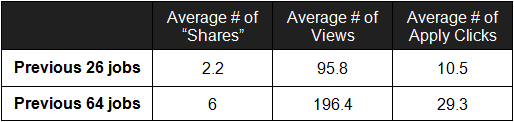
LinkedIn is becoming a great place for candidates to search for jobs – earning their reputation as the “world’s largest professional network.” We have been experimenting with the effectiveness of using the “share” button to spread the news about job openings with our clients. Our data found that the more people who share your company’s job, the more exposure it will get.

Taking a sample of 26 jobs posted on LinkedIn (from 8/20/12 to 9/20/12), with an average of just 2.2 shares per job, we saw an average of 95 people viewing each job.

However, taking a sample of our 64 jobs (from 6/20/12 to 9/20/12) we had an average of just over six shares per job and an average of 196 views for each job that was posted. Additionally, the first set of data average just over 10 apply-clicks per job, whereas the second averaged 29.

LinkedIn Share data

The data show the number of apply clicks and views is directly correlated to the number of shares.

Types of jobs that don’t draw well with social media advertising

Obviously there are factors outside of how many times a job is shared. The job itself is paramount: A bad job won’t get candidates even if everyone knows about it (everyone will just know it’s a bad job). Another factor is what type of job you’re posting on social sites. Typically, blue collar jobs or hands-on jobs will not draw as well on the internet. The same goes for face-to-face jobs like waiting tables and bartending. The reason for this simply stems from the type of person who is being searched for – an employer must know who the ideal candidate is in order to know how to reach that person.

Types of jobs that do draw well on LinkedIn

We’ve found that management-level positions advertised on LinkedIn tend to do draw well. The reason could simply be that management-level employees understand the importance of having professional networks, and thus use the website regularly. In addition to administrative positions, which are wildly popular everywhere, the most commonly applied for position level was management.

Sales positions have also performed well on LinkedIn as it is a rapidly changing/moving industry, and those candidates are prone to using professional networks to connect with prospects, leads and other companies. Sales reps are always on the move and are always needed somewhere. As such, it comes with the territory to stay up on technology and be active in finding new ways to survey the sales landscape. Additionally, sales representatives know that LinkedIn is an effective sales tool. It is useful to find information about a lead before making a call. As such, sales reps are already using the site, so it makes sense that they’re reachable on the site.

Promoting on other social media sites

As far as the other social sites, they are far behind LinkedIn from an employment standpoint. Facebook boasts targeted pay-per-click advertisements and various company-apps for job-searches, but there isn’t a go-to platform to utilize the network. In the same vein, Twitter is good for sharing jobs and telling people that they’re available, but it does not yet offer a way of knowing how effective it can be as a job-promotion tool.

Takeaway

As you can see, how effectively sharing your jobs on Linkedin has a significant effect on the amount of candidates who will apply for the job. Make sure to encourage your employees to share your company’s jobs as it will extend the reach of each advertisement.

Have you used social media to promote your job ads? How has it worked for you?

Image Credit: http://www.flickr.com/photos/coletivomambembe/

With unemployment still above normal numbers, it’s easy for employers to expect to be flooded with applications as soon as their position is posted. However, there are times when a job advertisement garners little or no applicants at all. In these cases, it leaves the employer bewildered and maybe even a little angry. Before you throw up your hands, here are a few questions for you to consider that may enhance your applicant pool.

Is your job getting the most exposure that it can get?

In recent history, employers have been relying on the traditional job boards, such as Career Builder, Monster, Craigslist, and specific industry niche job boards for their advertisements. Those sites still garner favorable numbers, but with the rapid expansion of the internet there are a multitude of websites that can be utilized for posting your job. According to r4stats.com a site that analyzes the world of analytics, Indeed.com is the most popular job search site in the world, and the cost is free to employers.

Is your job advertisement attractive to applicants?

Have you asked yourself why would someone want to work here? Have you made that clear in your advertisement?

Just because people are out of work does not mean they will be clamoring for anything and everything. It is important that you highlight what sets your position apart from the other positions in your industry. Aside from a competitive salary, are you offering your applicants a chance to learn, grow and flourish? Employees don’t just want a paycheck anymore, they value training & development programs, opportunity for growth and see the value their work brings to the company

Are you expectations realistic?

There are some jobs that will only appeal to a select few, and even they may not be what you are looking for. If your position is “hard to fill” it is important that you recognize the challenges that come along with it, as patience is important to have when looking for the perfect candidate.
These are just a few questions to ask yourself if you are not getting the traction you want on your open position.

What questions do you have when it comes to building a candidate pool?

Photo courtesy of andjohan via Flickr.

As part of our ongoing commitment to offer the best value to our customers, we’re constantly looking for more ways to increase advertising for all NewHire job ads. We’re excited to announce our new partnership with Glassdoor.com, the largest career community on the web, which now publishes all NewHire job ads on their job board. This partnership increases your job ad’s exposure to even more candidates — at no additional cost!

This now marks FOUR carefully selected job boards that all NewHire jobs are published to for free (The NewHire Job Board, Indeed, SimplyHired, and now Glassdoor).

On behalf of the NewHire team, thank you clients for your ongoing business!


You can’t get away with posting a short ad in the local newspaper anymore. Today’s recruiting landscape has so many options out there to help you with your next hire – everything from job ad packs, to software, to fully-outsourced recruiting services. Question is, how do you know which one is right for your company?

I’ve seen the recruiting and hiring landscape change quite a bit in my 24 years of recruiting, but one thing stays the same. Before small and mid-sized businesses start hiring, they need to first evaluate their need. This includes taking a look at the urgency of the hire, how much knowledge/experience they have of hiring, and how much time they have to invest in order to determine the tools they should use. If you don’t have the right tools or sufficient time, your project will probably be doomed to failure.

I put together a little evaluation to help you make a realistic assessment of your organization’s recruiting strengths and weaknesses. Use this recruiting evaluation to rate yourself on the following 5 statements:

  1. Before we start recruiting, we have a concise written statement identifying our target candidate and the impact we expect that person to have on our organization.

Never ………………….. Sometimes …………………… Always

  1. Once we start recruiting, we assign one person the responsibility to see the project through and that person has the time and the know-how to do it right. 
Never ………………….. Sometimes …………………… Always
  1. We know where to go (websites, social media, associations, networks, referrals) to generate sufficient candidates to find the right person for the job. 
Never ………………….. Sometimes …………………… Always
  1. After candidates begin to apply, we have a process to identify the top talent and engage with them within 5 days of their application.

Never ………………….. Sometimes…………………… Always

  1. As the process unfolds we continue to review candidates until we are confident we have the right person for the job, rather than settling for someone we think is “good enough.”
Never ………………….. Sometimes …………………… Always

Congratulations to you if you answered “Always” to all of the above. Using your own internal resources and well-chosen advertising you’ll find the right talent. You may find it even more advantageous to use inexpensive web-based recruiting tools to both advertise your open position and keep track of your candidates. Either way, you’re on the right track.

If you answers were more “mixed,” you should consider taking advantage of additional recruiting resources and outside expertise. For example, you may understand who your target candidate is and have someone in your organization who will recognize that person when they see them, but you may not have the tools and expertise to find the candidates to choose from. You can get help with setting up your recruiting and advertising and do the screening and interviewing yourself. We find that those with mixed answers are great candidates for recruiting services like our Elements and Basic software and service packages.

For those folks whose answers were “Never,” it may be best to get outside help. Though that help may seem expensive upfront, the cost of obtaining recruiting expertise will dwarf the potential costs of hiring on your own. Not only will you waste time and money in figuring out the recruiting yourself, but the likelihood that you hire the wrong person is significantly increased. Nothing is more expensive than hiring the wrong person! We find that businesses that fall here need a full-service recruiting solution like our NewHire Professional package.

What hiring/recruiting processes have you used in the past? How have they worked for your company?