Archives For Recruiting Best Practices

Hiring & recruiting best practices for small and mid-sized businesses.

Maybe you have seen them while prowling around Internet job boards. I call them “Do Not Enter” ads. They are job advertisements that focus on turning away unqualified candidates instead of luring in qualified candidates. Postings with this type of job ad jargon meant to keep candidates away are everywhere.

Whether by habit or another reason entirely, hiring managers still use job application jargon to keep certain candidates from applying. The main focus should be on getting the right candidate in the door, not keeping candidates away. They use jargon that is specific to their workplace, “need not apply” statements, and other fence-building tactics to keep unqualified candidates out.

I understand the logic here. If only qualified candidates apply, a hiring manager only has to sort through resumes and applications that deserve attention. But at what cost? Is it possible that the right candidate – the person who is the most perfect fit for your job – is also being turned off by that job-specific jargon?

Shouldn’t we be more focused on attracting the right candidate than turning away the wrong ones?

job ads jargon turns away candidates

Luckily, in a tech-world, there is a technological solution. Applicant tracking systems have made sorting through your candidates as easy as a click of a mouse. Modern technology alleviates the concern that you may have to filter through hundreds of resumes. With online job applications, resumes are a thing of the past. Tossing out resumes and using modern ATS technology will allow us to make the best possible hire for our companies by luring in the right candidates and sorting out the wrong ones quickly. Not turning them away, but rather sorting them out.

Ultimately, hiring is about one important thing: finding the right candidate for your job. We believe there is a special candidate out there for every job. And in an era of simple online applications, those candidates are trying to figure out quickly whether they can perform the tasks described in an ad. If your ad is full of jargon, the likelihood is much higher that it will be ignored, and the right candidate for your job will be out of your line of vision.

Open the gates!

If you are stuck between discouraging unqualified candidates and avoiding blocking the candidate from applying, the choice is simple. Open the gates and let as many candidates in as possible. By searching key points in an online application, an employer can save time and money that would have been spent reading through resumes. Then, more time can be spent on the four or five candidates most likely to be the one.

So go back and take a look at your most recent job advertisement. Did it use jargon? Were you focused on making sure certain candidates didn’t apply? Take the “need not apply” statements out of your job description and replace them with statements that get candidates excited to apply.

Give job seekers a few sentences to let them know whether your job is one they would like to work in or not. If I’m a job seeker, what four or five things will I be doing on a daily basis that will add value to the company? What is your company all about? What makes it a great place for me to work? And what tangible things qualify me or disqualify me from competing for this job? Answer those 4 questions in a way that’s easy to understand, and your job advertisement will get you more qualified candidates.

Using technology, the application sorting process is easier, and by extension, the application writing process is easier. Now all your focus can be on attracting the right candidate to apply, which is the best way to get the ideal employee for your company.

According to data from the NewHire applicant tracking system, at least 90 percent of candidates who apply for any advertised job opening are unqualified. That means that if you’re the hiring manager, and you get about 100 resumes, you’ll spend two or three days screening resumes just to find the 10 people who are qualified. That doesn’t even take into account the additional time needed for face-to-face interviews! Luckily, there is a solution – adding candidate screening questions as the first step in the application process.

The challenge is that candidate screening questions have to be created before a single candidate applies, but it’s simple if you remember this broad formula.

screening questions are critical to qualifying job applicants


There are three screening questions that should be on every employment application:

  1. Past work experience relating to the key accountabilities of the job
  2. Work behaviors that lead to on-the-job success
  3. Specific subject matter expertise needed to execute the duties of the job

Here are some specific examples, all based on an ad for an outside sales representative in the property and casualty insurance space:

The right Sales Representative will have 2-5 years experience in a Sales or Business Development role and excel in working in a fast-paced environment. Property and Casualty License preferred, but not required. Strong communications skills are a must.

Our goal is to be able to quickly identify candidates who have the skills and experience expressed in the ad. Below are examples of specific questions that address each of the three categories. These questions can be easily adapted for sales-rep recruiting in other industries.

1.   Past work experience

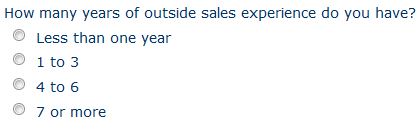
It’s clear we want to hire someone with some sales experience. Here’s the first question to ask:

Capture1

This is a great first question to ask because it immediately filters candidates who don’t match your simplest criteria. The problem is that there are applicants who have been selling for years but doing it poorly. Here is a second screening question that would help us find out about selling success.

Capture2

Now we can select candidates who meets our criteria of both experience and demonstrated success during the last 12 months.

2.   Work behaviors that lead to on-the-job success

Now we can turn our attention to “soft skills.” From the job description we know that successful employees are comfortable working in a fast-paced environment.

Capture3

This is a great question to ask, because candidates can’t Google the correct answer and not every sales job requires the same work pace. In this case, it’s probable that candidates who select “juggling several tasks with attention to detail” will be most likely to thrive.

3.   Subject matter expertise

Now it’s time to find out which candidates can demonstrate they have the knowledge for success.

Capture4

The ideal answer is clear. But the ad said, “Property and Casualty License preferred, but not required,” and the hiring manager is willing to train the right candidate. How am I going to identify candidates that might not have the license yet, but would likely have the ability to learn about the industry and pass the exam?

Capture5

The information provided by an open-ended question is two-fold. First, we get a writing sample and can evaluate communication skills. Second, we find out if the candidate has a basic understanding about the industry and can explain the benefits of the product they will be selling.

Every employment application should include screening questions about work experience, work behaviors and subject matter expertise. These types of questions allow the manager to eliminate candidates who are not qualified and focus on those people who match the hiring criteria. Using the right screening questions will transform a tedious task into a rewarding, exciting search for the best available talent.

What screening questions do you use in your hiring process?

Recruiting sales people, always be recruiting

Recruiting sales people is hard. It takes time, effort, money, attention, patience, persistence and more. Huh… finding and hiring sales reps takes the same effort and tactics required to sell a product or service. Coincidence or not?

But even if you dedicate yourself to the list above, your chances of making the wrong hiring choice are greatly increased if you fail to follow these 3 keys to recruiting sales people.

  1. Define the role:  which type of sales rep do you want to hire?

Dave Kurlan’s OMG assessment can be configured to screen for 14 different sales roles. Howard Stevens of the Chally Group defines 14 sales specialties. Saying you need to hire a sales rep or account manager is not good enough. Do you mean inside sales of a service? Outside sales of a commodity product? Enterprise sales? Account Management? Each choice has consequences for how you source, screen, assess and hire.

  1. Don’t hire on experience:  favor the right behaviors and motivations over experience

While experience is a good teacher, it is also a poor indicator of future success. When reviewing the experience of candidates for sales jobs, it is rare to find a candidate whose experience is so close to your selling situation that you can use it as an indicator. Almost always, the variables from one company to the next (even when they sell the exact same product or service) are too great to be able to compare apples-to-apples.

The crazy part is that you already know this. When I recently asked 75 business leaders responsible for hiring sales people, how many of their experienced hires were successful, two raised their hands. When I asked how many still included years of experience in their job descriptions, all raised their hands!

  1. Never give up – never give in: Recruit, recruit, recruit and only hire when you find the right person

Question: When’s the right time to hire a great sales rep?

Trick question!

Answer: when you find her.

But… if you are not looking how will find her? You won’t. Great sales companies recruit sales talent continuously. If you use a great multi-step screening process, using a valid assessment, it does not have to take up all your time.

Make sure that you have the tools, time, authority and accountability to ALWAYS BE RECRUITING.

Hiring the right person for your team can be a very difficult undertaking. It is costly, time consuming, and emotionally taxing if you do not meet the person you are looking for in a timely fashion.

The first thing to look for when searching for a great employee is somebody with a personality that fits with your company culture. Most skills can be learned, but it is difficult to train people on their personality. If you can find people who are fun, friendly, caring and love helping others, you are on to a winner. – Richard Branson

hire skill set personality

It may seem that focusing primarily on skills set would be the best solution to simplify the hiring process. You have an open job, and you need someone to do it.

Though true, it is also important to think long term about the team you are trying to build. You may discover that the right personality is what you need to grow the performance of your team in the long haul.

Here are three ways to break away from the “exact skills” hiring trap:

Look for Transferable Skills Instead of Exact Skills

To save time on training it may seem that you need someone to jump right into the role with minimal supervision. Yet, people do bring their own way of doing things, and time must be spent on acclimating them to your procedure and processes. Could it be worth it to you to spend some extra time educating the right fit on more fundamental aspects of the job?

If you spend time examining their transferable skills you may find that the time to get them up to speed is much quicker that you envisioned initially.

Consider Team Morale

Bringing on a new team member is a change. And changes bring mixed emotions within an existing team. Even if they are stretched thin, your team will prefer to spend their time with someone who fits in rather than with someone who can do the job but is challenging to work with.

A Harris Interactive study shows that 51 percent of employees stay with their company when they like the people they work with.

So, include a couple of long term employees in on your interviewing process if it is not already part of your process. They will feel appreciative that you value their opinion, and both parties will get an early insight into their potential relationship.

Overall, keeping your existing team members in mind. Slow down your frantic search and instead invest careful time in a worthwhile search: http://business.time.com/2012/08/31/top-reasons-why-americans-stay-at-their-jobs-and-what-it-means-for-the-presidential-campaign/

A New Skill Set Can Bring New Opportunities

If you tend to make hiring decisions based on the same skill-set formula, you may be missing out on a new direction for your company. Individuals who have different skills than what you are looking for have advantages. They most likely been in different environments, and have a new and different perspective that could be useful to your team.

Barring an extreme mismatch, someone who brings complimentary skills to an existing job could be just what you need to invigorate your organization.

These are just a few suggestions to keep in mind when in it comes to making your next hire.

Do you agree or disagree that it could be beneficial to keep personality as the focus for your next hire?


In the first part of this article on the skills gap myth I explained how to overcome the skills gap myth by increasing the size of your talent pool.  But getting more candidates into the pool isn’t the only way to address the skills gap.

There’s a reason the “skills gap” isn’t called the “skills void.” Technically, you can find qualified candidates for every skill set imaginable.  There’s just a lot of competition between employers for those talented few.

The companies that do the best in these competitive industries are the ones who are the best at snatching up and retaining those skilled employees. It’s not luck that allows them to retain their talent; it’s a focused effort to make their company more appealing.

skills gap myth - corporate culture matters

Watch for the Culture Gap

Google isn’t struggling to attract programmers because programmers want to work for Google.  Google has done an amazing job of creating a corporate culture that people want to be a part of – they understand what their ideal employees want and they deliver it.  If you can create that kind of culture at your company, your perception of the skills gap will change too.

If you’re struggling to bring on new talent or are hemorrhaging the talent you do have, then it’s probably because your company is losing this culture battle. Fix that: Examine your company culture and see what new ideas you can implement to make your company more attractive to candidates. If your company stands out as a great place to work then you’ll attract more of the available talent.

Conceptualization Gap

The conceptualization gap is the discrepancy between what it takes to get the job done and what you think it takes to get that job done. A dentist with a background in home appraisals? A social media marketer with 20 years of experience?
 
As absurd as these examples are, they are no different than packing on a list of unnecessary requirements for your job. When you have a tight candidate pool, there’s no reason to cut candidates for not possessing skills you don’t need from them.  Your first priority in hiring is to bring on someone who can do the job. If you need extra qualifications just for kicks, then you’re needlessly disqualifying candidates.  A near-perfect candidate has three years of experience instead of five? So what?
 
Even the wording in your job app betrays the conceptualization gap.  Today’s job descriptions are full of vague terms about intangible traits that aren’t critical to do the job.  In fact, it does the exact opposite because every candidate ends up believing that description fits them.
 
Think hard – are all your requirements essential to doing the job and do they truly qualify applicants?  If not, you need to retool the job description to focus on the actual skills you need to have the job done right.

Compensation Gap

While the other gaps point out how you’re not making the most of your current, dwindling candidate pool, this gap is about why that pool is shrinking to begin with.

There’s a reason why through-out history we see spikes in education and specialization in certain areas. It’s usually the professions that pay well.

Many of the industries that are suffering from the skills gap used to serve as the backbone of America’s blue-collar middle class. So what happened over the last 40 years that dissuaded people from pursuing those careers? Those workers stopped being able to support a family on those wages. The outgoing crop of skilled workers came into their industries earning enough to afford a mortgage and car loan, with enough left over for vacation and retirement. What are the prospects for the replacements you want to bring in?

But the compensation gap isn’t just about paying skilled candidates more. It’s also about paying what it would take to draw your ideal candidates away from other industries.

How much would it take to get a mechanic to change industries and join your team? How much would it take to get that high school student to pass on culinary school and join your apprenticeship program instead? It’s those questions that will set you on the path to closing the “compensation gap” and attracting the quality candidates that you want.

The gulf between skilled jobs and qualified candidates is often seen as a sickness, when in fact it’s a symptom of poor hiring practices. Don’t just treat the symptoms! Employers are the ones who stand to benefit the most from curing the sickness, so the onus is on you to find and take the right prescriptions.

Focus on what you need to make your business the best business it can be, for you and your employees, and you’ll see just how ephemeral that “skills gap” is. And if you’re still having trouble, take two Elements and call us in the morning…☺.

Imagine if it was your job to make sandbags. You head over to the beach with a bunch of empty burlap sacks and a rake because the beach is obviously where you go if you want sand.  After a full day’s work, you’ve barely managed to fill even one sack.  Would that mean that there just isn’t enough sand on the beach?  That there’s a sand gap?  No. It would mean you tried to use a rake to scoop up sand. That’s what the skills gap myth looks like: trying to solve hiring needs in an ineffective way, coming up empty, and then blaming your troubles on a “skills gap.”

Like sand on the beach, the skills you need are on the market; you need to adjust your recruitment methods to discover them.

Any gap that exists isn’t because of a lack of talent, but rather a lack of effective sourcing on the part of employers. If we’re going to fix the perceived “skills gap,” we need to first tackle the underlying causes that affect your ability to find qualified candidates.

skills gap myth

Manage the Aptitude Gap

Sourcing qualified candidates often gets undermined by employers fixating on job experience. The logic goes that the only people qualified to fill your position are the ones that have done X job for Y years and know how to use Z program. Unsurprisingly, this line of thinking will only uncover a fraction of the qualified talent that’s available.  Even in an industry with standardized positions and skill sets, putting too much emphasis on experience will lead you to ignore candidates who have the aptitude to learn on the job.

Skills are not innate abilities, magically awakened at puberty like X-Men powers — they are learned. Everyone learned their job skills from someone else. Your company should be that “someone else” for the right candidates.

Invest in understanding what core competencies are necessary for new employees to learn what you have to teach. Then, tailor your sourcing to identify those traits in your candidate pool. That simple adjustment to your hiring process will result in a deeper pool that contains both candidates who can do the job now and those who will be able to do the job in time.

Address the Training Gap

Do you know an industrialized nation that doesn’t have a skills gap problem? Germany. Why don’t they? Because they have almost 17 times more people per thousand enrolled in apprenticeships than we do in America.  A 2009 National Household Education Survey (NHES) found that only 1% of Americans have reported being in an apprenticeship.

Maybe “apprentice” still hearkens back to days of young boys sent to oppressive homes to learn silver-smithing, only to have their hand disfigured in a smelting accident (Have you not read Johnny Tremain?!).

But the purpose of apprenticeships isn’t to cripple able-bodied lads; it’s to teach a new generation of workers a set of skills they don’t already have. Historically, this is how civilization prevented a “skills gap,” yet employers today have decided to give up on that tried and true method.

You already have the talent and knowledge of your employees at your disposal, so use them to help train the next generation of employees.  Formalize this process into a real training program.  It can be done in house, as a collaborative effort with other business in your industry, or with the assistance of local schools.  If you don’t do anything, then you’re just letting that valuable knowledge base go to waste and leaving positions at your company unfilled.

If you choose to do it in house, there are a few steps to get started:

  1. Designate an area in your workplace where employees can learn, practice, and implement the skills you’re teaching.
  2. Encourage employees to find a mentor and formalize that relationship by asking the employee’s manager to check in periodically with the mentor.
  3. Keep an eye out for new technologies. Employees learn faster when they’re excited about something new.

Training alone still won’t be enough. In the second part of this article we discuss the conceptualization and culture gaps, which both play a role in the propagation of the skills gap myth.

Read on for, The Skills Gap Myth: The Effects of Culture, Conceptualization and Compensation.

So – you’ve got an open position and have been working tirelessly to tweak your job ad to be as appealing as possible to your target candidates. You’re now faced with the choice of…where to put it?

Which are the best job boards?

Best Job Boards

In the past, the answer would have been simple – put it on CareerBuilder and you’re done.  You’d maybe put it on HotJobs or Monster.com too if your colleagues suggested it.  Now, though, the job board landscape is a lot more crowded and figuring out the best job boards can be a confusing task.

Do you go with CareerBuilder? Craigslist? What about LinkedIn? Or Indeed?  Or the multitude of smaller job boards that target specific industries or locations?

At  NewHire, we keep an eye on the major job boards and help keep the ones with the best results on top.  That’s why we switched away from Monster.com a few years ago when its performance started dropping and replaced it with LinkedIn, which had better recruiting traction.  We keep our eyes on the job boards to make sure our jobs get the most exposure. And from the data we’ve collected, the short answer to the question “Are all job boards equal?” is no.

We’ve blogged before about the performance of the job boards we regularly post on, and have found Indeed to be the clear champ in getting your job out there.  So much so that Indeed does twice as well as Craigslist, CareerBuilder and LinkedIn combined.  As a result of that we’ve gone to offering paid Indeed sponsorships as part of our packages.

But that’s just the short answer – does this mean that you should just post on Indeed and forget about all of the others?  Not necessarily….

Overall, Indeed clobbers the competition in sheer numbers, but other factors can boost a job’s appeal on a particular job board or boards.  We’ve also written about how to sponsor jobs on Indeed, which has proven to attract almost double the number of job seeker views.

Your job might be very appealing to new grads and pull many applicants from college job boards.  Or maybe you’re in a city where CareerBuilder or Craigslist still have a lot of pull, so it would be wise to post on there.  You could be looking for a very specialized role, so you might want to target a smaller niche job board to find the best candidates.   Location, Industry, Job Type….these all can factor into how a position will perform on job boards.

So – to sum up…post on Indeed, but also take a look at where you are and what kind of job you’re hiring for, because there will be some more specialized job boards in your area that are well worth the time to post.

Or, give us a call and we’ll help steer you in the right direction!

Using a recruiter can be a great way to save you time, energy and resources when hiring. We all know it’s not a quick (or easy) process, but sometimes you just need a little help. Is using a recruiter hurting you more than helping you? That scenario is definitely possible. Keep reading to figure out if your recruiter is a pro or a con.

using a recruiter hurting Quiet, monotone, unenergetic, negative, mean and even down right rude.  These are the perfect adjectives to describe the next Bond villain but maybe they aren’t perfect adjectives to describe your recruiter. If the aforementioned adjectives could be used to describe your recruiter, it’s highly likely using a recruiter is hurting your chances.

As a candidate who is interested in a position within your organization, I want to work with a recruiter who I wouldn’t mind seeing in the office every day. If your recruiter is kind, friendly, helpful and really organized, you can bet they are helping you hire. Remember, job candidates are screening you too. You need to put your best foot forward from the very beginning.

A recruiter within an organization can wear many hats, but their number one job is to present you with qualified candidates.  The recruiter was hired to hire!  Through a set of processes, they present qualified candidates to the decision makers of the company. There are a number of pro tips and tricks we’ve compiled over the years we’ve been helping small and medium businesses hire.

Let’s look at the things that will hurt you more than help you:

  • Your recruiter has a bad attitude or bad vibe
  • The recruiter isn’t excited about the company or position
  • The recruiter isn’t selling the opportunity
  • The hiring managers don’t trust the recruiter’s decisions
  • The hiring managers aren’t seeing qualified candidates
  • There is no recruiting process or organization
  • The recruiter isn’t following up with candidates

If any of those sound familiar to you, using a recruiter is hurting you when trying to hire. But don’t worry too much. Using a recruiter isn’t always bad, and it can actually be extremely efficient and helpful!

Here are the things that will making using a recruiter helpful to your organization:using recruiter helping

  • The recruiter answers the phone as if they are the one interviewing
  • The recruiter always has a positive attitude
  • The recruiter presents the company in a positive and professional manner
  • The recruiter keeps detailed notes in a database
  • The recruiter is excited about the job and company
  • The hiring managers trust the recruiter’s decisions
  • The recruiter gives the candidate feedback
  • There is an outlined and consistent process including follow up

Does that sound familiar? We hope so. Because that means your recruiter is absolutely helping you make the right hire!

Using a recruiter is something many people are on the fence about because they don’t want to find themselves resonating with the first list. The question isn’t necessarily whether or not you should use a recruiter, because clearly they can be very helpful, but it’s about finding the right recruiter. You want one that’s going to help, not hurt. They’re out there. You just have to be selective.

You’ve narrowed your candidate pool down to a chosen few and are ready to check the backgrounds of your top candidates. Criminal background checks are in order. After all, you don’t want to hire a criminal, right? Seems simple, but like most issues in recruiting and hiring, the process can be complex with hidden pitfalls.

conviction records

Lest you think that this problem doesn’t come up very often, take a look at the front page of the Wall Street Journal from August 19, 2014. The article reports that the FBI criminal database contains arrest records for 77.7 million Americans, an astounding 33% of adults.

Perhaps the most common pitfall for employers is not understanding the difference between an arrest and a conviction in making hiring decisions. Here is the difference according the Federal Equal Employment Opportunity Commission (EEOC):

Difference Between Arrest Records and Conviction Records

The fact that an individual was arrested is not proof that he engaged in criminal conduct. Therefore, an individual’s arrest record standing alone may not be used by an employer to take a negative employment action (e.g., not hiring, firing or suspending an applicant or employee). However, an arrest may trigger an inquiry into whether the conduct underlying the arrest justifies such action.

In contrast, a conviction record will usually be sufficient to demonstrate that a person engaged in particular criminal conduct. In certain circumstances, however, there may be reasons for an employer not to rely on the conviction record alone when making an employment decision.

Bottom line: You shouldn’t deny employment to a candidate based on an arrest record.

conviction records hiring, employee criminal background check

Even more so, you shouldn’t go Googling around looking at “mug shot sites” to find out if your potential new employee has ever been arrested. Conviction records are another matter. You generally can (whether or not you should is another matter) use criminal conviction records to deny employment. The most common exception to this is if you are engaging in pattern of discrimination against a protected category of people and using criminal conviction records for crimes unrelated to job duties to deny employment.

So what’s an employer to do? Here are some basic rules:

  1. Do NOT use arrest records to make hiring decisions.
  2. Do ask if candidates have been “convicted of a felony.”
  3. Do inform candidates that you will be doing pre-employment backgrounds and obtain the candidates’ written consent.

One thing that you can do to work around this process is ask candidates if there is anything you will find on their background check that they’d like to tell you before you run it. It is much easier to deny employment to someone who has lied in the current recruiting process than for any kind of past action.

The takeaway here is that you cannot use arrest records when hiring. You can use conviction records, but you cannot use them to discriminate. Essentially, if the conviction directly affects the potential hire’s ability to do the job, you can use it. If it is unrelated, you may be at risk.


This is the third of a three-part series that’s designed to help you answer the question “why is it so hard to hire an employee?” 

We’ve addressed what may be the problem if no one is applying for your job and why qualified applicants aren’t applying, but what if you have plenty of qualified candidates applying? You might be thinking, “what’s the problem?” The obvious answer is: There is no problem with having plenty of qualified candidates. The problem comes when you have no follow up.

What do I do if I have plenty of applicants but no follow up?

Don’t kick yourself for not following up. It happens. There are many reasons why you may find yourself lacking in this department.

no time to hire an employeeMost small- and mid-sized employers wait to hire an employee when there is enough business to support a new employee. That means that everyone in your office is currently working at capacity. Everyone is slammed handling customers, orders and other immediate tasks. That doesn’t leave anyone with the time needed to properly hire an employee.

Other times, we find ourselves hiring in “emergency mode.” When people take new jobs, retire or get fired suddenly, you need someone quick. But you also need to get their work done. No wonder you don’t have time to follow up; you’re currently doing two jobs!

Maybe you’re not slammed for time but there is no clear delegation of work responsibility for following-up with the top candidates. The President, Owner or manager got the ball rolling, but is too busy to see to the details. Who takes it from there?

Or perhaps it’s just too much to handle in additional to the regular work load. That’s possible. Especially in the case of smaller companies that might not have a dedicated HR staff or recruiter.

It takes a lot of time to hire an employee, so it’s certainly not something you can “just squeeze in.”

hire an employee phone interviewConsider this: It takes 30 to 45 minutes to conduct a phone interview. Let’s say you want to conduct 10 or 12 phone interviews so you can have 3 or 4 quality candidates for face-to-face interviews. That’s 540 minutes or 9 hours just to do the phone interviews. Wow! No wonder you don’t have time.

That 9 hours doesn’t include the time it takes to identify the best applicants, or the time it takes to send emails, set appointments, leave voicemails, or deal with the interruptions when the candidates call back. And all of those steps must be taken. That’s a lot of time!

So what do you do? You either work crazy hours, shift priorities or you can ask for help. There is nothing wrong with reaching out for help, but it’s best not to wait too long to do that. The best candidates don’t stay on the market for long.

As soon as you recognize that you don’t have the necessary time required to hire an employee, take action to remedy it. Either shift priorities or reach out to someone that can help bear some of the burden. We don’t recommend the ‘work crazy hours’ option.

For more information read Part 1 and Part 2 of this series.

If you are having this problem now, feel free to reach out to us. We’re pros at helping you find the right person for your job.